

6.2.3.1. The Perceptron#
The perceptron is the atomic building block of every neural network. Before anything else - before layers, before backpropagation, before deep learning - there is one neuron taking inputs, computing a weighted sum, and producing an output.
If you understand the perceptron, you already understand the computation at the heart of every modern neural network.
The Core Idea#
The perceptron is a direct extension of the models you have already encountered:
Model |
Computation |
Output |
|---|---|---|
Linear Regression |
\(\hat{y} = \mathbf{w}^\top\mathbf{x} + b\) |
any real number |
Logistic Regression |
\(\hat{p} = \sigma(\mathbf{w}^\top\mathbf{x} + b)\) |
probability in \((0,1)\) |
Perceptron |
\(\hat{y} = f(\mathbf{w}^\top\mathbf{x} + b)\) |
depends on \(f\) |
The only difference is the choice of activation function \(f\). By swapping \(f\) we change what the neuron can output - and this generalisation is exactly what makes neural networks so flexible.
The Math#
A single perceptron computes two steps:
Step 1 - Pre-activation (linear sum):
This is identical to linear regression: a weighted sum of all input features plus a bias term \(b\).
Step 2 - Activation:
The activation function \(f\) introduces non-linearity. Common choices:
Activation |
Formula |
Range |
Typical use |
|---|---|---|---|
Step (original) |
\(\mathbf{1}[z \geq 0]\) |
\(\{0, 1\}\) |
Classic perceptron |
Sigmoid |
\(\frac{1}{1+e^{-z}}\) |
\((0, 1)\) |
Output layer, binary |
Tanh |
\(\frac{e^z - e^{-z}}{e^z + e^{-z}}\) |
\((-1, 1)\) |
Hidden layers |
ReLU |
\(\max(0, z)\) |
\([0, \infty)\) |
Hidden layers (default) |
ReLU (Rectified Linear Unit) is the dominant choice for hidden layers today - it is simple, fast, and avoids the vanishing gradient problem that plagues sigmoid and tanh in deep networks (more on this in Deep Learning and Practical Tips).
Learning rule: The perceptron updates its weights after each misclassified training example:
where \(\eta\) is the learning rate. This rule converges (for the step activation) if the data are linearly separable - the Perceptron Convergence Theorem. For non-linearly-separable data it will not converge; that is why we need gradient descent and multi-layer networks.
In scikit-learn#
sklearn.linear_model.Perceptron implements the classic linear perceptron with a step activation. It is equivalent to a linear SVM trained using the perceptron update rule.
from sklearn.linear_model import Perceptron

p = Perceptron(max_iter=1000, eta0=0.1, random_state=42)
p.fit(X_train, y_train)
y_pred = p.predict(X_test)
Key attributes after fitting:
p.coef_- weight vector \(\mathbf{w}\) (one row per class in multi-class OvR)p.intercept_- bias terms \(b\)p.n_iter_- number of passes over the data until convergence
Note: The sklearn Perceptron uses the hard step decision; it does not output probabilities. For probability estimates, use LogisticRegression or MLPClassifier.
Example#
from sklearn.linear_model import Perceptron

p = Perceptron(max_iter=10000, random_state=42)
p.fit(X_train_sc, y_train)

train_acc = accuracy_score(y_train, p.predict(X_train_sc))
test_acc  = accuracy_score(y_test,  p.predict(X_test_sc))
The perceptron achieves a test accuracy of 0.929 - strong for such a simple model, because the digit classes are well-separated in the scaled 64-dimensional pixel space. Train accuracy of 0.966 is close, showing no memorisation.
Visualising What the Perceptron Learns#
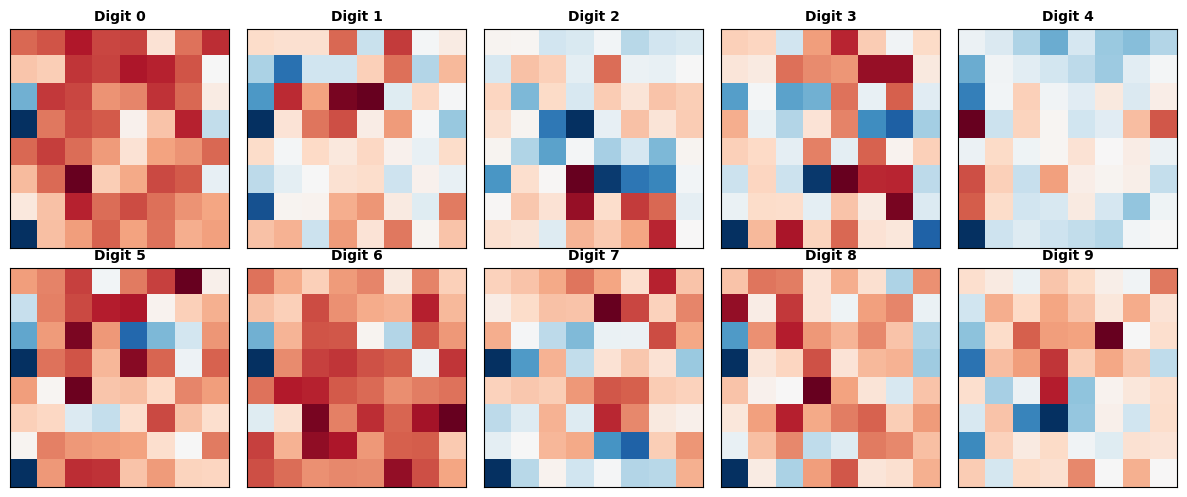
Each of the 10 classes learns its own weight vector — a 64-dimensional template reshaped into an 8×8 image. Pixels with large positive weights push the prediction toward that class; pixels with large negative weights push against it.
Note
This visualisation is a rough sketch — the weight templates from a linear perceptron are noisy and hard to interpret. A deeper network trained with backpropagation would produce much cleaner, more structured weight patterns.
fig, axes = plt.subplots(2, 5, figsize=(12, 5))

for digit, ax in enumerate(axes.ravel()):
    weights = p.coef_[digit].reshape(8, 8)
    ax.imshow(weights, cmap='RdBu_r', interpolation='nearest')
    ax.set_title(f"Digit {digit}", fontsize=10, fontweight='bold')
    ax.set_xticks([])
    ax.set_yticks([])

plt.tight_layout()
plt.show()
The Activation Functions Side by Side#
z = np.linspace(-4, 4, 300)

activations = {
    "Step": (z >= 0).astype(float),
    "Sigmoid": 1 / (1 + np.exp(-z)),
    "Tanh": np.tanh(z),
    "ReLU": np.maximum(0, z),
}

fig, axes = plt.subplots(1, 4, figsize=(14, 3.5), sharey=False)

for ax, (name, values) in zip(axes, activations.items()):
    ax.plot(z, values, lw=2.5, color='steelblue')
    ax.axhline(0, color='black', lw=0.7, ls='--')
    ax.axvline(0, color='black', lw=0.7, ls='--')
    ax.set_title(name, fontweight='bold')
    ax.set_xlabel("z")
    ax.grid(True, alpha=0.3)

plt.tight_layout()
plt.show()
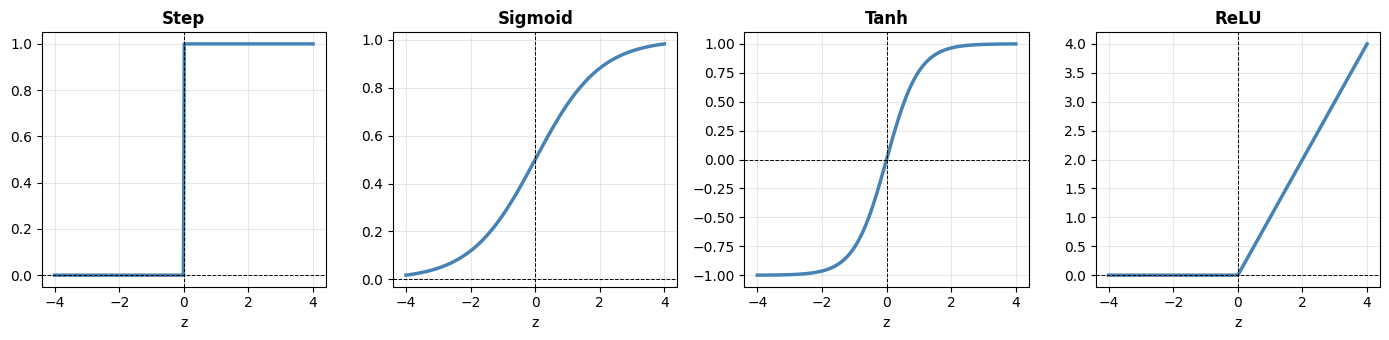
ReLU has zero gradient for \(z < 0\) (the “dead neuron” problem for some neurons) but near-linear gradient for \(z > 0\), making it much easier to train deep networks than sigmoid or tanh, which saturate and kill gradients at both extremes.