LoopTool — When Tool-Use Training Needs a Closed Loop
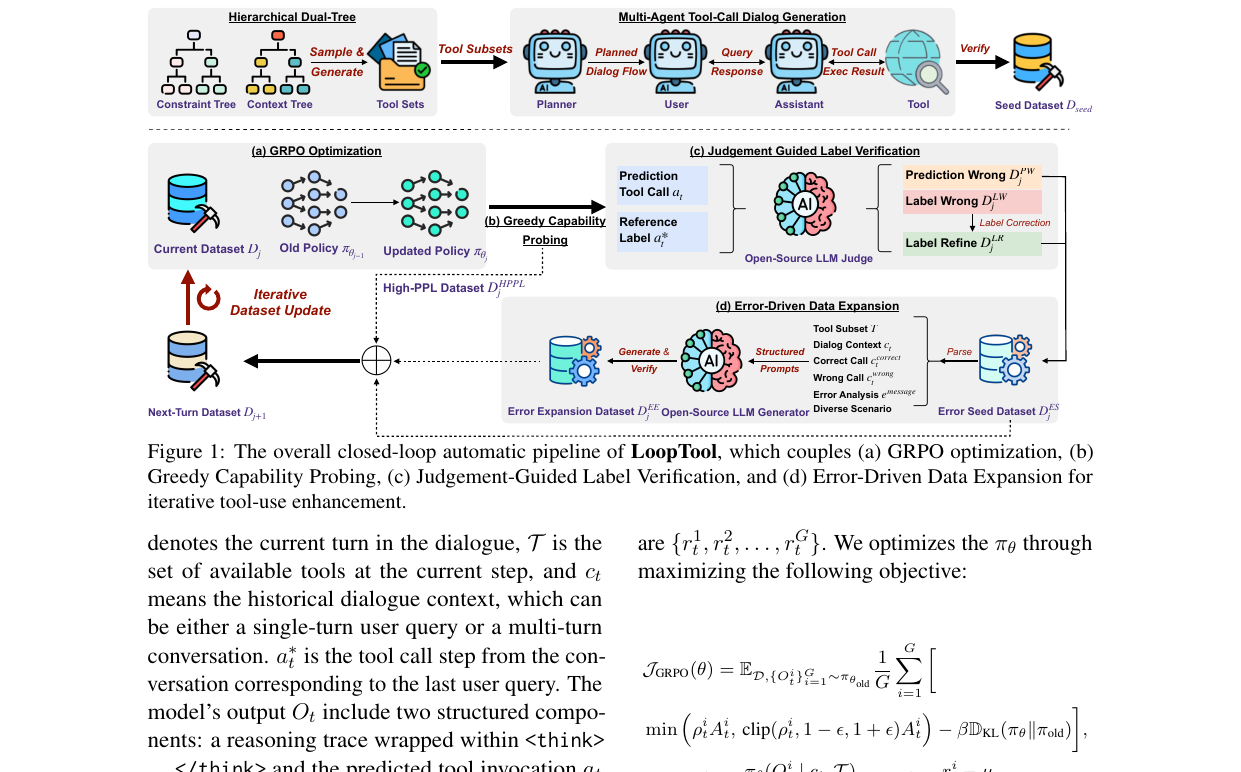
Most tool-learning pipelines still look like this: synthesize a big function-calling dataset once, fine-tune or run RL on it, ship the model. The data never learns what the model still gets wrong, and noisy synthetic labels stay in the mix.
LoopTool: Closing the Data–Training Loop for Robust LLM Tool Calls (Zhang, Jiao, Du, Yu, Lu, Liu, and Zhang, ACL 2026) argues that tool-use post-training should be model-aware: each round of training should probe failures, fix bad labels, and grow hard examples before the next GRPO pass.
The Paper
Paper: LoopTool: Closing the Data–Training Loop for Robust LLM Tool Calls (Zhang et al.)
Venue: ACL 2026 (Long Papers)
Topic: LLM tool use, synthetic data, GRPO, iterative data evolution, function calling.
Code: github.com/DeepExperience/LoopTool
The Problem and Why It Matters
Agents that call APIs, query databases, or run calculators depend on training data that matches real tool schemas and multi-turn dialogue. Static synthesis (ToolLLM, APIGen, ToolACE, and similar pipelines) can scale volume, but it treats the model as a passive consumer. Easy cases waste capacity; hard cases stay rare; wrong annotations look like ground truth.
Closed APIs for generation and judging add cost and hurt reproducibility. Open-source judges are cheaper but noisier. LoopTool tries to get quality without a proprietary loop: one open model (Qwen3-32B) for judging and expansion, GRPO on Qwen3-8B, and no paid API in the core pipeline.
The Method
The system has a seed stage and an iterative loop.
Seed data. APIs come from public collections plus hierarchical dual-tree synthesis (context tree × constraint tree). Four agents—Planner, User, Assistant, Tool—simulate multi-turn tool dialogs. Rule checks (schema, types) plus Qwen3-32B verification filter bad dialogs into (D_{seed}) (~28k tool-call samples).
GRPO training. Each turn becomes a tuple ((\mathcal{T}, c_t, a_t^*)): tools, context, reference call. The policy emits a reasoning trace and a <tool_call> block. Reward is binary ToolMatch at the AST level (function name + arguments).
Each iteration then runs three modules:
-
Greedy Capability Probing (GCP). Greedy-decode on the training set. Matches are “mastered”; mismatches go to judgment. High-perplexity mastered cases are kept as borderline replay ((D_j^{HPPL})).
-
Judgement-Guided Label Verification (JGLV). Qwen3-32B compares prediction vs. reference:
PRED_WRONG,LABEL_WRONG,BOTH_CORRECT, orBOTH_WRONG. Wrong labels are replaced with the model’s better call; genuine errors feed expansion; both-wrong samples are dropped. -
Error-Driven Data Expansion (EDDE). Failure seeds are rewritten into (k) new scenarios with diversified context but the same core difficulty, then re-verified into (D_j^{EE}).
The next dataset merges error seeds, expanded data, high-PPL replay, and a shrinking slice of fresh seed ((D_{j+1}) in Eq. 5 in the paper). Four iterations are used in the final system.
What They Find
Benchmark gains at 8B scale
On BFCL-v3, LoopTool-8B reaches 74.93% overall accuracy—+8.59 over Qwen3-8B and ahead of the Qwen3-32B model used as generator and judge. It ranks third on the public leaderboard snippet in the paper, with the best reported single-turn AST and live execution scores among compared models at its scale.
On ACEBench (English), LoopTool-8B hits 73.4% overall (+6.3 over Qwen3-8B), leading open 8B models in that table.
The loop beats more data alone
Figure 2 contrasts true iterations with training longer on the same seed. Closed-loop evolution gains steadily through four rounds; the static seed-only curve plateaus by iteration 2 and slips by iteration 3—classic overfitting on a fixed distribution.
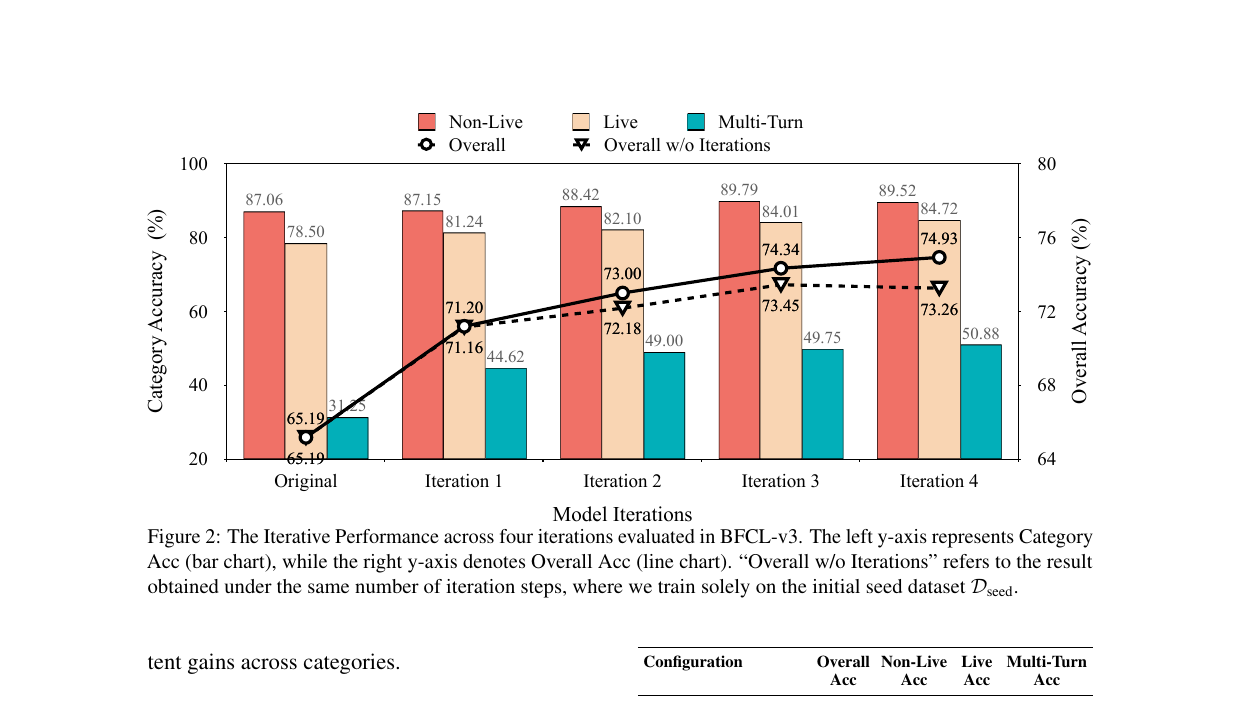
Open-loop controls (random expansion, random error seeds, easy-to-hard reordering only) all trail the full system, with the largest gap at iteration 4 (+1.98 vs. open-loop volume-matched expansion).
Ablations and curriculum
Removing JGLV hurts badly—noisy labels poison both training and EDDE. Dropping EDDE or high-PPL replay also lowers accuracy, especially on multi-turn cases. Repeating the same error seed without diversification is weaker than EDDE’s variants.
Across iterations, data gets harder (higher PPL, more multi-turn turns) and failures shift from syntax/schema (~9% → ~0.5%) toward reasoning and context (~58% of remaining errors at iteration 4).
Generalization
LoopTool-8B does not collapse into “tools only.” On MMLU-redux, IFEval, LiveCodeBench, Math-500, and AIME24/25, it matches or beats base Qwen3-8B—for example +3.84 on LiveCodeBench and +10 points on AIME24 in the paper’s table.
Limitations
LoopTool is offline and strictly iterative: the next data round starts only after GRPO finishes, so there is no streaming co-evolution. Evaluation centers on BFCL-v3 and ACEBench with binary ToolMatch rewards—richer tool ecosystems, stateful APIs, safety constraints, and reward shaping are left open.
Compute is non-trivial (four GRPO rounds plus judging and generation), though the paper reports costs in the appendix and avoids closed API bills.
Future Directions
The authors’ limitations sketch a roadmap; a few extensions seem especially important for practitioners.
Online and streaming loops
Tighter train–probe–expand cycles—updating the data buffer while GRPO runs—could react faster to deployment drift. That matters for agents whose API catalogs change weekly.
Richer rewards and judges
Binary match is auditable but blind to partial credit, safe refusal, or multi-valid calls. Structured rubrics, process rewards, or verifier models for stateful tools could pair with JGLV-style label repair.
Broader tool ecosystems
Real products mix SQL, browsers, enterprise APIs, and long-horizon state. Stress-testing LoopTool on τ-bench-style dual-control or domain-specific tool suites would show whether EDDE generalizes past function-calling leaderboards.
Judge and generator independence
The 8B student beating its 32B teacher is striking, but judge bias could still propagate. Future work might ensemble judges, use smaller specialist verifiers, or separate “expand” and “verify” models.
Integration with SFT warm starts
The paper focuses on pure RL after seed GRPO. Hybrid SFT → LoopTool or mixing human-curated tool traces into (D_{seed}) could stabilize early iterations for smaller backbones.
Ideas for Our Work
LoopTool is another case where aggregate training loss hides the wrong failure mode—format errors vs. planning errors vs. bad labels. That rhymes with how we evaluate models in the UF Data Studio.
Diagnostic slices for agents. InsightBoard tracks metrics by slice during training. Tool agents need the same: single-turn vs. multi-turn, live vs. AST, hallucination relevance—LoopTool’s BFCL breakdown is essentially a slice report; logging it per iteration would make the loop auditable in production.
Conflict and invariance tests. PIH work tests when text overrides evidence. Tool calling has an analogue: prompts that imply the wrong API or arguments while the dialog context is clear. Closed-loop expansion could target those prompt–schema conflicts the way EDDE targets greedy failures.
Label repair as fairness signal. JGLV treats “model better than label” as first-class. In fairness settings, mislabeled or biased subgroup annotations play a similar role—comparative judgment might refine supervision without regenerating entire datasets, parallel to entity-bias auditing that asks when the reference answer, not the model, is wrong.
For more information about our research, return to our homepage: ufdatastudio.com.