InsightBoard at FLAIRS-39 in Marco Island
Paper + Venue + Topic
I presented InsightBoard: An Interactive Multi-Metric Visualization and Fairness Analysis Plugin for TensorBoard with my advisor Christan Grant at the 39th International FLAIRS Conference (FLAIRS-39), held May 17–20, 2026 at the Hilton Marco Island Beach Resort and Spa on Marco Island, Florida. The paper appears in Vol. 39 No. 1 of the FLAIRS proceedings (DOI: 10.32473/flairs.39.1.141478). It sits at the intersection of interactive machine learning, responsible AI, and fairness in ML—topics that ran through much of the main track and the Explainable, Fair, and Trustworthy AI special track.
FLAIRS has a long tradition of pairing strong AI research with a relaxed, collegial setting. Marco Island delivered on that promise: sessions in the resort, conversations spilling onto the beach, and a program that mixes invited talks, tutorials, special tracks, and posters without the crush of a mega-conference.

The Problem + Why it Matters
Training dashboards like TensorBoard are built around aggregate metrics—loss, accuracy, mAP. That is enough when a single number tells the whole story. It is not enough when a model looks healthy on average but fails specific subgroups.
Object detectors are a concrete example. YOLOX can reach strong mAP on BDD100K while still under-detecting pedestrians in rain, at night, or in particular demographic groups. Conventional monitoring hides those gaps because it never asks for whom performance is improving. Fairness tools, when they exist at all, often sit outside the training loop: you finish training, export predictions, and only then discover disparities.
InsightBoard is motivated by the need to see fairness and performance together, during training, without rewriting your pipeline. Practitioners need to correlate heterogeneous metrics, slice by environment or demographic attribute, and catch subgroup failures early—before they ship a model that looks fine on a leaderboard but behaves unevenly in the field.
The Method
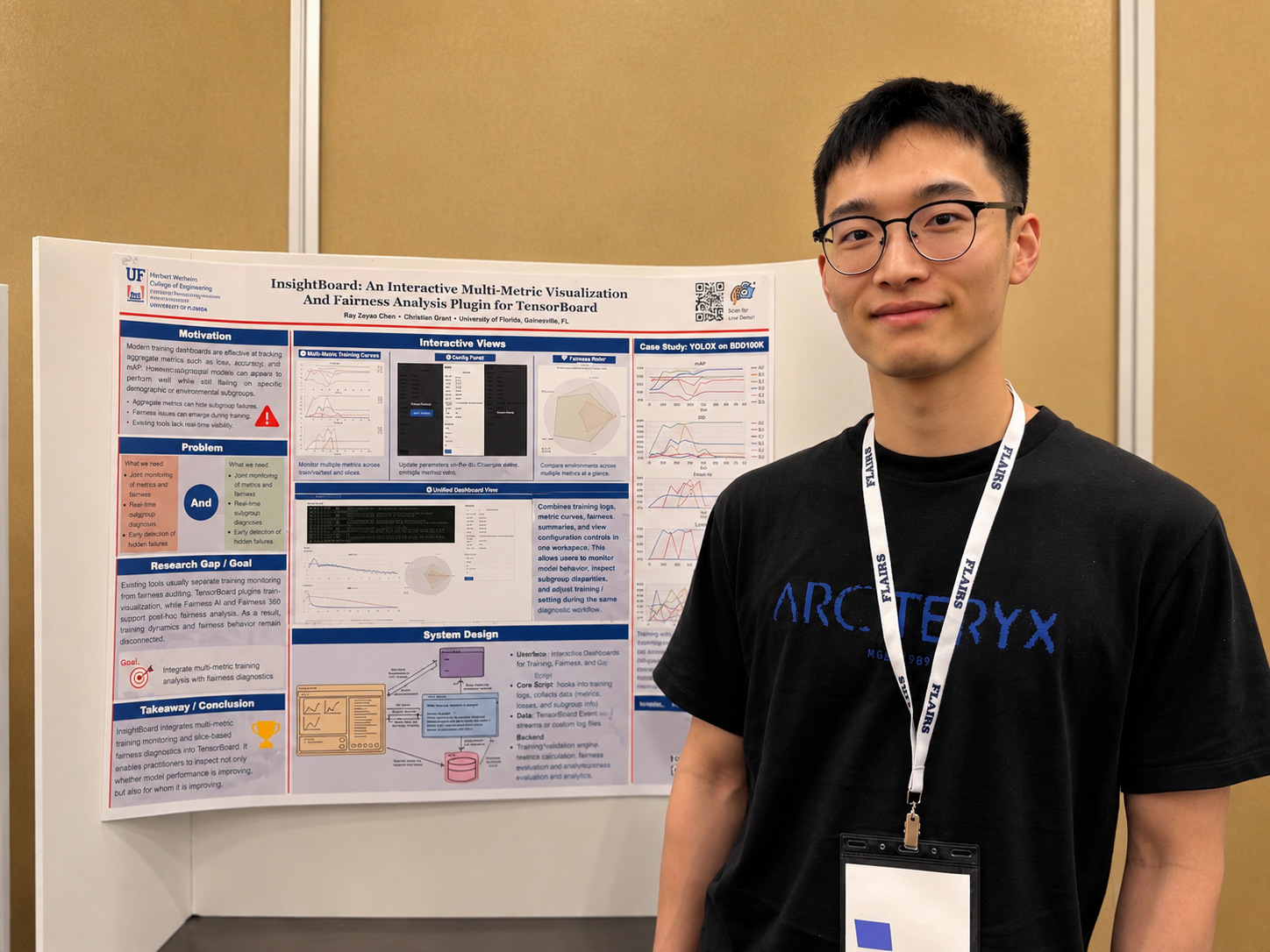
InsightBoard is a TensorBoard plugin. It reads standard event files from an existing training run and adds a unified workspace on top of them.
The interface combines four linked views:
- Multi-metric training curves — monitor several metrics across train, validation, and test splits, broken out by user-defined slices.
- Config panel — adjust visualization parameters on the fly without restarting training.
- Fairness radar — compare environments across multiple metrics at a glance.
- Unified dashboard — training logs, metric curves, fairness summaries, and configuration controls in one place.
Under the hood, a core script ingests TensorBoard event files, computes standard group-fairness indicators over slices the user defines, and links plots so that selecting a slice in one view highlights it everywhere. Correlation analysis connects metrics that standard dashboards treat as unrelated.
We evaluated InsightBoard with a case study on YOLOX trained on BDD100K. Models with strong aggregate mAP still showed substantial environmental disparities—exactly the pattern that single-metric monitoring misses. Because InsightBoard hooks into TensorBoard rather than replacing the trainer, it adds no new data store and requires no changes to the training script beyond enabling the plugin.
What is Genuinely Novel
Existing fairness toolkits and training dashboards each do part of the job. Fairness libraries compute disparity metrics post hoc; TensorBoard tracks scalars one at a time. InsightBoard's novelty is the synchronized multi-view integration: fairness diagnostics, heterogeneous metrics, and slice-based exploration in a single interactive session tied to live training dynamics.
The linked-plot design matters. When a practitioner sees mAP climb while a fairness radar plot diverges across weather conditions, the failure mode is visible in context—not buried in a spreadsheet exported after the fact. To our knowledge, no other TensorBoard plugin combines multi-metric correlation analysis with slice-based group fairness indicators in this way.
Limitations
InsightBoard depends on the user defining meaningful slices. If slice labels are coarse, missing, or misaligned with the deployment environment, the fairness views can look clean while real harm persists.
The BDD100K case study focuses on environmental attributes (weather, time of day, scene type). Demographic fairness requires metadata the dataset may not provide, and the plugin does not infer protected attributes on its own.
Finally, InsightBoard surfaces disparities; it does not correct them. It is a diagnostic instrument, not a debiasing method. Practitioners still need separate strategies—reweighting, augmentation, constrained optimization—to act on what they find.
Related Work at FLAIRS-39
The full proceedings span main-track papers, seven special tracks, tutorials, and posters. Below are sessions I found especially relevant to fairness, trustworthy AI, and interactive ML—plus one from our own lab.
From the UF Data Studio (Applied NLP special track). Detravious Brinkley and colleagues presented An Elicitation-Matrix Approach to Pragmatic Context Modeling in Low-Resource Machine Translation: The Case of Akuapem Twi. Their elicitation-matrix method models pragmatic context for Twi–English translation—a different problem from fairness monitoring, but aligned with our broader interest in building NLP systems that respect linguistic and cultural context rather than treating all text as interchangeable.
Explainable, Fair, and Trustworthy AI special track. Several papers spoke directly to themes InsightBoard touches:
- A Fairness-Aware Semi-Supervised Clustering Method (Maier et al.) embeds fairness constraints into clustering rather than inspecting them after the fact.
- Fairness Implications of Data Minimization in Deep Collaborative Filtering (Li et al.) shows that privacy-preserving data reduction can shift recommendation fairness—a reminder that the slices we monitor must include indirect effects.
- A Seven-Layer Lifecycle Framework for Fair, Robust, and Safe AI (Heydari & Nyarko) maps guidance across the full model lifecycle, from data collection through deployment.
- A Landscape of Trustworthy AI Frameworks and Metrics (Hatcher et al.) surveys how existing frameworks align with the NIST AI Risk Management Framework.
Main track and posters. Towards Fair Pay and Equal Work: Imposing View Time Limits in Crowdsourced Image Classification (Lim et al.) addresses fairness in the data pipeline itself—relevant because slice quality in InsightBoard starts with how training labels are produced. Improving LLM Thematic Analysis through Metric-Driven Self-Correction (Im & Park) takes a metric-driven monitoring angle on LLM outputs, parallel to our multi-metric view for vision models.
Invited talks worth noting. Diana Inkpen's talk on explainable neural text classifiers and the special-track invited session on AI You Can Trust: Communication-Aware, Ambiguity-Sensitive, and Interpretable NLP for High-Stakes Domains (Dorr et al.) framed interpretability as a prerequisite for deployment in settings where mistakes carry real cost—the same motivation that drives fairness monitoring during training.
Ideas for Our Work
The first idea is to extend InsightBoard beyond object detection. The TensorBoard plugin architecture is model-agnostic; we plan to integrate it with classification and NLP training runs in the UF Data Studio, where subgroup failures are equally easy to miss under aggregate accuracy.
The second idea connects to the fairness-clustering and lifecycle-framework papers from the trustworthy-AI track. InsightBoard currently reports standard group indicators; we want to explore lifecycle-aware alerts that fire when a disparity crosses a threshold relative to an earlier checkpoint, not just relative to other slices at the same epoch.
The third idea comes from Detravious's Twi translation work. Fairness in vision often focuses on demographics and environment; fairness in language must also account for pragmatic and cultural context. A future version of our monitoring stack could treat discourse-level attributes (register, dialect, genre) as first-class slices, not afterthoughts.
The fourth idea is collaboration. FLAIRS's smaller scale made it easy to talk through poster sessions with researchers working on complementary problems—crowdsourcing fairness, trustworthy-AI frameworks, metric-driven LLM correction. We are following up on several of those conversations for joint benchmarks and case studies.
For more information about our research, return to our homepage: ufdatastudio.com.
For more from Ray on fairness in ML, interactive visualization, and responsible AI, visit: Research Homepage, or contact via email at chenz1@ufl.edu.