Enactor — Surrogate World Models for Traffic Intersections
Traffic planners often ask "what if?" before changing a lane, retiming a signal, or closing a corridor. Microsimulators like SUMO make those experiments cheap, but the behavior models inside them are hand-crafted. They assume average drivers with smooth reactions, which makes it hard to reproduce the messy, interaction-heavy dynamics that show up at real intersections.
Enactor takes a different path. Instead of tuning another car-following equation, it learns a surrogate world model from simulation data and rolls out vehicle trajectories in closed loop for thousands of seconds. The paper is Enactor: From Traffic Simulators to Surrogate World Models by Yash Ranjan, Rahul Sengupta, Anand Rangarajan, and Sanjay Ranka at the University of Florida.
The Paper
Paper: Enactor: From Traffic Simulators to Surrogate World Models (Ranjan, Sengupta, Rangarajan, and Ranka)
Venue: arXiv preprint (March 2026)
Topic: Traffic microsimulation, world models, multi-agent trajectory generation, intersection dynamics.
The Problem and Why It Matters
Intersections are where traffic gets hard. Vehicles negotiate tight geometry, respond to signal phases, and react to each other in ways that are hard to encode with a single rule set. Classical models like the Intelligent Driver Model or Krauss car-following work well enough for average flow, but they struggle with aggressive maneuvers, rare safety-critical events, and the compounding errors that appear in long closed-loop rollouts.
Deep learning trajectory predictors have improved interaction modeling, yet most still focus on short-horizon forecasting for autonomous driving. They are not built to run a full intersection for an hour while staying physically plausible. Enactor targets that gap: a data-driven simulator that can replace SUMO's behavior model after a short warm start and keep generating traffic for 40,000 timesteps (4,000 seconds at 0.1 s resolution).
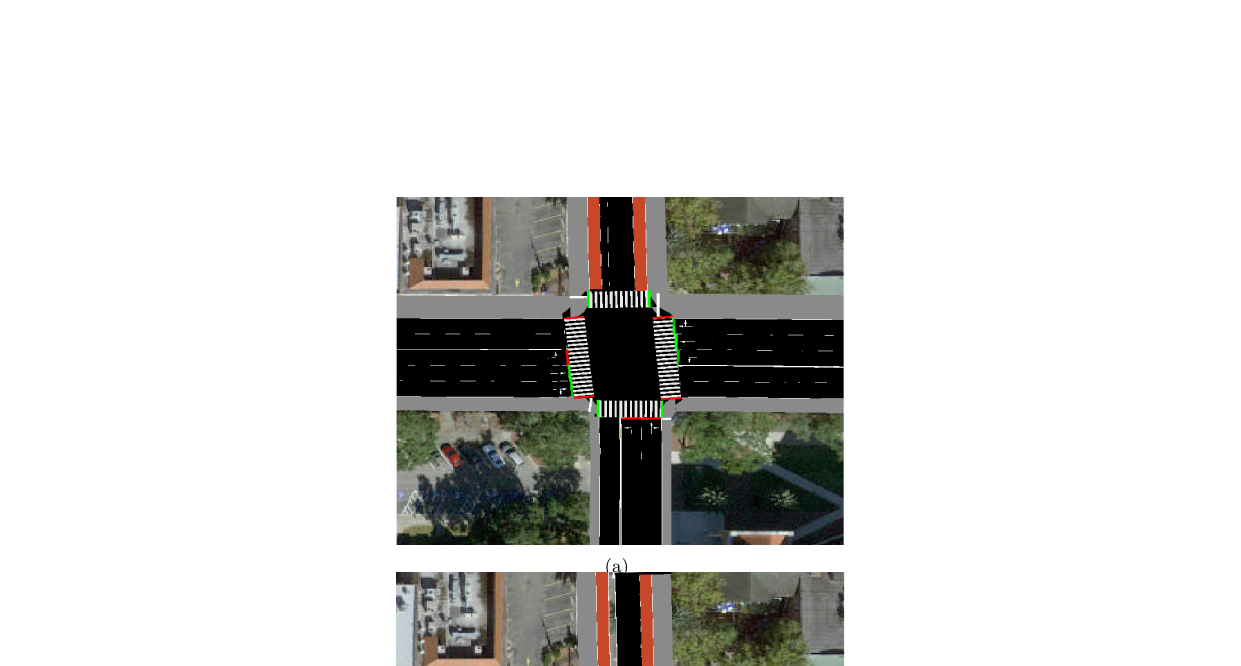
The evaluation setting is local and concrete. The authors build digital twins of two signalized intersections in Gainesville, Florida, including West University Avenue at NW 17th Street. They compare Enactor against IntTrajSim, a recent intersection-focused baseline, using both trajectory reconstruction metrics and traffic-engineering safety indicators.
The Method
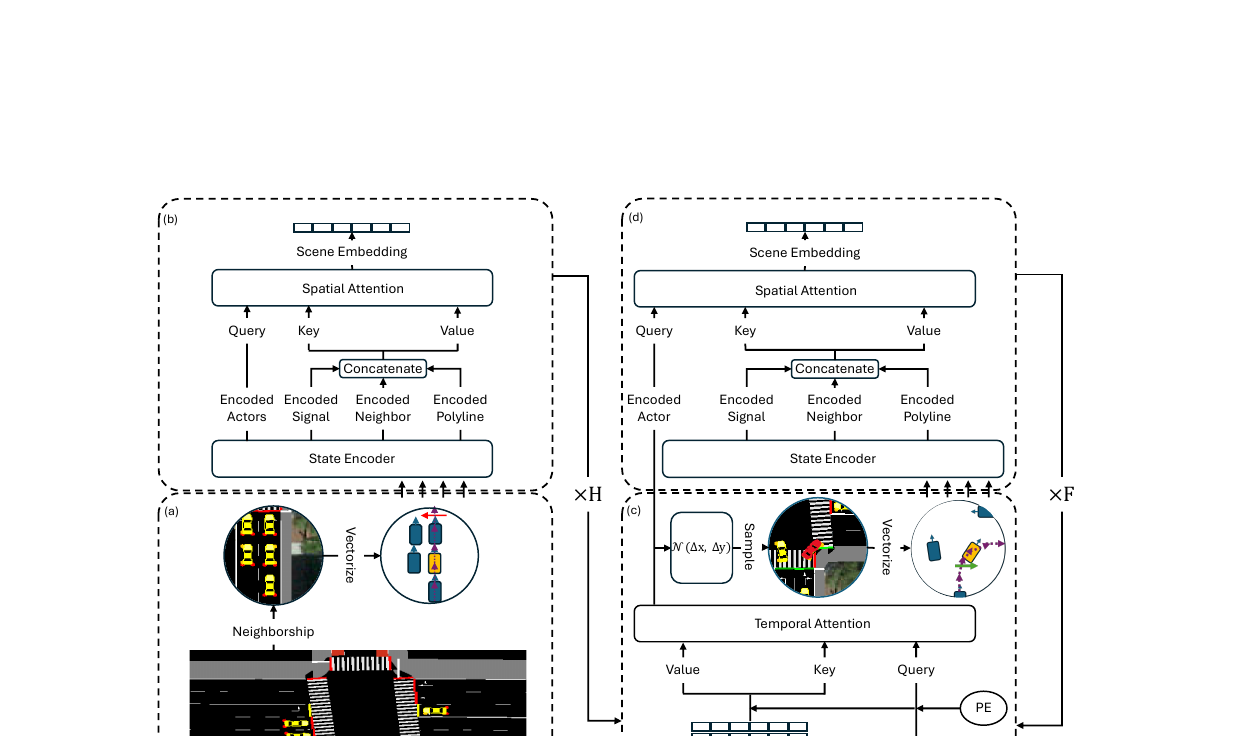
Enactor follows a world-model framing. Each vehicle is an actor whose next state depends on local map geometry, traffic signals, its own history, and neighboring agents. States are represented in polar coordinates around the intersection center—radial distance, angle, speed, and heading—which fits curved intersection motion better than raw Cartesian coordinates alone.
The architecture has two attention stages:
- Spatial attention fuses the ego vehicle with nearby map polylines, signal stop lines, and neighboring agents at each timestep.
- Temporal attention rolls those spatial embeddings forward across a prediction horizon, parameterizing a Gaussian over the next displacement.
Training uses negative log-likelihood on 2D displacements. At inference, the model samples the next state, re-encodes neighbors, and feeds everything back in—a standard closed-loop rollout that is simple in principle but difficult to stabilize over long horizons.
Data comes from SUMO itself. The authors simulate six hours of traffic per intersection (about 1.24 million training exemplars), using Krauss car-following for the ground-truth dynamics and signal timing matched to the real intersections. In the simulation-in-the-loop test, SUMO still handles arrivals and signal phases, but Enactor takes over vehicle motion after a short warm start.
A small ablation turned out to matter a lot. The base model often decelerated in the right situations but stopped in the wrong place—overshooting stop lines or rear bumpers. Adding the neighbor's rear-bumper position as an explicit input (Enactor(N)) fixed much of that behavior and sharply improved intersection-aware safety metrics.
What Is Novel
Three design choices stand out.
Polar geometry for intersections. Most trajectory models use Cartesian coordinates. Enactor's polar representation aligns actor states and map polylines with the radial structure of a signalized crossing, which is a natural fit for curved approach paths and lane topology.
Closed-loop training at intersection scale. The model is not evaluated only on one-step displacement error. It is stress-tested as a surrogate simulator for multi-minute, even multi-hour, rollouts. That is closer to how planners actually use microsimulation.
Intersection-aware evaluation, not just ADE/FDE. The paper adopts metrics from prior UF work on generative intersection models: red-light violations, mid-intersection stoppages, pre-stopbar stoppages, unsafe deceleration, and time-to-collision events. Low reconstruction error does not guarantee rule-compliant traffic; Enactor is judged on both.
On aggregate traffic statistics, the results are strong. Against IntTrajSim on the first intersection, Enactor matches ground-truth speed and travel-time distributions much more closely—KL divergence improves by more than an order of magnitude on travel time (0.00190 vs. 0.04043) and by roughly 5× on speed (0.0024 vs. 0.0112). After the rear-bumper ablation, Enactor(N) also beats the baseline on red-light violations and several other safety counts.
The honest caveat is TTC. Both Enactor variants still generate too many close-encounter events relative to raw SUMO data, usually because a vehicle fails to brake hard enough before reaching a leader. Aggregate realism and local safety are not the same problem, and the paper is clear about that gap.
Limitations
The study is intersection-specific and vehicle-only. Pedestrians, cyclists, and vulnerable road users are not modeled yet, even though intersections are where those interactions matter most.
Training data still comes from SUMO's Krauss model, so Enactor learns realistic simulated behavior before it learns realistic human behavior. Bridging that sim-to-real gap will need real trajectory logs, not just better architectures.
Generalization is promising but narrow. The second intersection test—removing middle east–west lanes—shows the model can adapt to modified geometry with retraining, but the paper does not yet demonstrate zero-shot transfer across unseen intersections.
Finally, safety metrics remain incomplete. TTC is a useful surrogate, but a full deployment story would need conflict typing, pedestrian exposure, and sensitivity to demand patterns and signal timing changes.
Future Directions
The authors point to three near-term extensions in the paper. I would group them—and a few adjacent ideas—as follows.
Transfer learning across intersections
The most direct next step is to learn driving behavior at one intersection and adapt it to new geometries with limited additional data. That would turn Enactor from a per-site model into something closer to a reusable traffic prior. For urban planning workflows, the payoff is large: planners could prototype lane removals, turn bans, or signal retiming on unseen networks without rebuilding the entire training pipeline from scratch.
Better close-range interaction modeling
TTC failures suggest the model understands deceleration qualitatively but not precisely enough at short following distances. Future work could add explicit car-following inductive bias, multi-step collision-avoidance losses, or hierarchical policies that separate free-flow motion from stop-line and gap-acceptance decisions. The rear-bumper ablation already shows that small geometric cues can unlock large safety gains.
Richer evaluation frameworks
Intersection-aware metrics are a step beyond ADE, but the field still lacks a standard battery for long-horizon surrogate simulators. Future benchmarks could report distributional fidelity (speed, headway, queue length), rule compliance, and safety surrogates jointly, with confidence intervals over random seeds and demand scenarios. That would make it easier to compare world models, agent-centric predictors, and classical microsimulators on equal footing.
Beyond vehicles
Real intersections are multi-modal. Pedestrian crossing phases, permissive left turns, and bike-box dynamics all change the feasible action space. Extending Enactor's actor graph to include pedestrians and cyclists—still in polar geometry around the conflict zone—would move the model closer to the safety questions practitioners actually care about.
Demand and control as first-class inputs
The paper notes that inbound flow rate and density are natural control parameters but not yet central to the learned dynamics. Conditioning Enactor on arrival rates, time-of-day demand, or alternative signal plans would let planners run richer counterfactuals: not just "what if we remove a lane?" but "what if volume rises 30% after a new development opens?"
Hybrid simulators
A practical deployment path may not replace SUMO entirely. SUMO is strong at network routing, demand injection, and infrastructure editing; Enactor is strong at learned local interaction. A hybrid stack—SUMO for logistics, Enactor for intersection dynamics—could offer the best of both without forcing planners to abandon existing tooling.
Ideas for Our Work
Enactor connects to the urban evaluation themes we care about in the UF Data Studio. Aggregate traffic statistics can look healthy while localized failure modes—unsafe following, signal violations, stuck queues—do real damage. That is the same structural problem we study in fairness and robustness: a scalar summary hides where the system breaks.
Three follow-ups feel especially natural from here.
Conflict probes for urban VLMs. As vision–language models start answering questions about street scenes, maps, and traffic footage, we need tests where a mild prompt error conflicts with visible evidence—wrong lane count, misstated signal phase, or an overstated vehicle count. Enactor-style simulation could generate controlled intersection clips with known ground truth, similar in spirit to prompt–image conflict probes for VLMs.
RISE-style diagnostics for traffic rollouts. Instead of one KL number on travel time, plot residual-like signals across demand bins, approach directions, or signal phases. Where does the surrogate diverge from SUMO or from logged data? Twin-knee and median-alignment views from RISE are built for model diagnosis; traffic simulation may need the same local lens.
Fairness across road users. Once pedestrians and cyclists enter the actor set, performance will not be uniform across modes. Monitoring subgroup outcomes—crossing delay, exposure to conflicts, stop-line compliance by movement type—fits the same responsible-AI mindset we apply to vision models in varying weather and lighting.
For more information about our research, return to our homepage: ufdatastudio.com.