Predicting Foam Characteristics of Body Wash Products
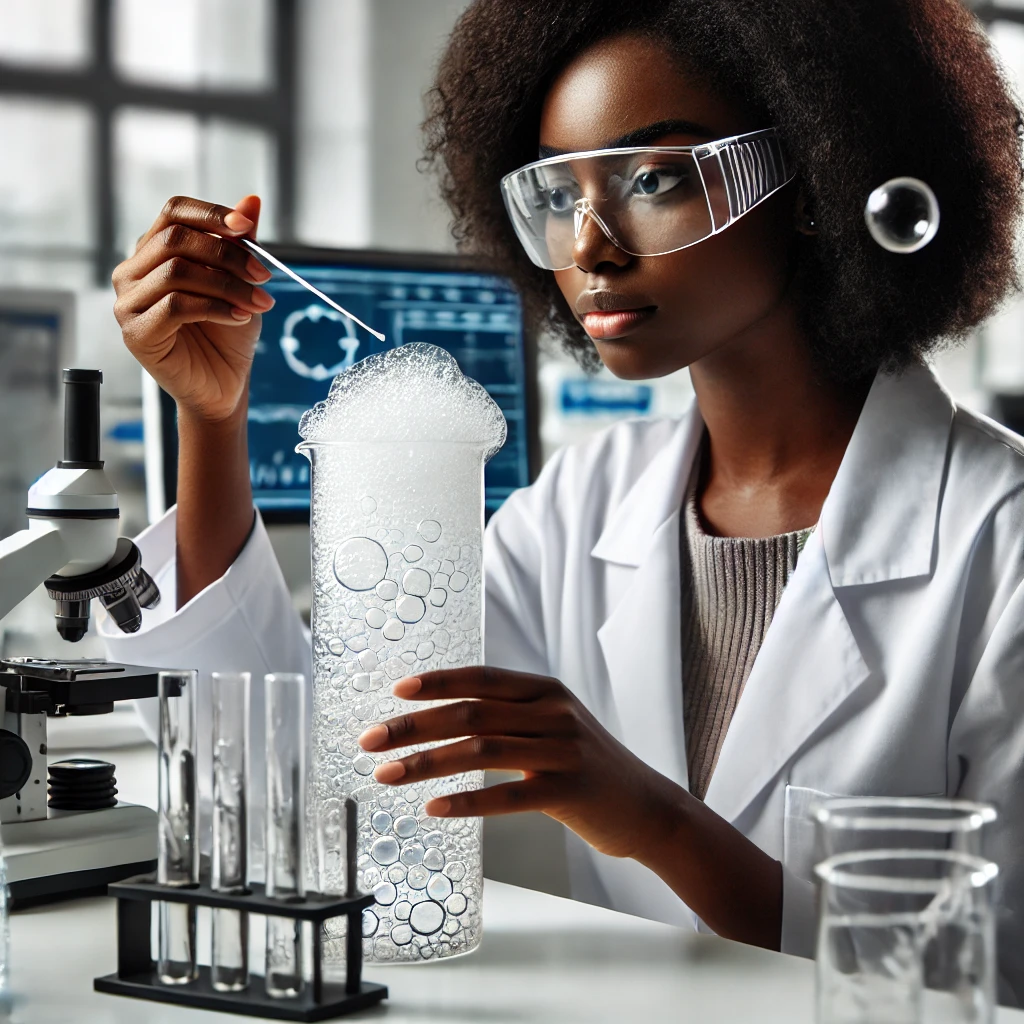
Foam is the first thing people notice when they use a body wash, and many associate it with getting clean. Some people want a creamy, dense lather and others want a large volume of foam. Both preferences trace back to measurable properties of the foam, but a body wash is a mixture of dozens of ingredients that interact in ways that are hard to predict. Formulators have typically relied on designed experiments, which means mixing and testing a new batch for every change. The number of batches grows exponentially with the number of ingredients being varied.
This project asks whether a model can learn those interactions from past products. Working with Colgate-Palmolive, we assembled 545 body wash formulations containing 362 distinct ingredients. Each formulation was whisked into foam in a Dynamic Foam Analyzer and tracked for 5 minutes. From the measurements we extracted 6 descriptors: maximum foam volume, the initial and final bubble count, the initial and final bubble radius, and the half-life of the bubble count as a measure of stability.
We trained 5 machine-learning models on ingredient concentrations. Tree ensembles beat the single decision tree and k-nearest neighbors. Random forest predicted the 6 descriptors with R² between 0.61 and 0.90, and it predicted bubble size and foam stability especially well.
SHAP analysis showed which ingredients drive each descriptor. Sodium laureth sulfate, cocamidopropyl betaine, opacifiers, fatty acids, and xanthan gum rose to the top across models. Xanthan gum and fatty acids lengthen foam life, which matches what colloid science predicts. Some results were surprising. The model assigned cocamidopropyl betaine a negative effect on foam volume, and it flagged preservatives as influential for bubble density. The paper reports these findings as open questions for chemists.
To show how formulators could use the model, we sampled 100 candidate recipes inside the range of ingredient levels seen in the data and predicted their foam. One candidate gave up about 10% of foam volume in exchange for a much denser foam. A formulator can find a recipe like that on a screen before preparing a sample in the lab.
Future work will connect these physical measurements to consumer sensory panel scores. The approach also applies to other liquid personal care products such as hand wash and face wash.
Video Overview
A narrated 5-minute walkthrough of the paper, with captions.
Links and Resources
Paper
- Jonghun Lee, Sivaramakrishnan Swamyna, Akshay Adithya, Viktor Dubovoy, Paul Thomson, Detravious Brinkley, Chibuzor Okocha, Christan Grant. Predicting Foam Characteristics of Body Wash Products using Machine Learning. ACS Omega. 2026. BibTeX
How to cite
@article{lee2026predicting,
    title = "Predicting Foam Characteristics of Body Wash Products using Machine Learning",
    author = "Lee, Jonghun and Swamyna, Sivaramakrishnan and Adithya, Akshay and Dubovoy, Viktor and Thomson, Paul and Brinkley, Detravious and Okocha, Chibuzor and Grant, Christan",
    journal = "ACS Omega",
    year = "2026",
    publisher = "American Chemical Society",
    doi = "10.1021/acsomega.6c03163",
    url = "https://pubs.acs.org/acsodf/article/doi/10.1021/acsomega.6c03163/5457742/Predicting-Foam-Characteristics-of-Body-Wash"
}