System for Future Reference Patterns
Paper + Venue + Topic
This paper Investigation of Future Reference Expressions in Trend Information by Yoko Nakajima, Michal Ptaszynski, Hirotoshi Honma, and Fumito Masui was published in the Big Data Becomes Personal: Knowledge into Meaning: Papers from the AAAI Spring Symposium in 2014. This research explores detecting expressions which refer to future events, predicting the future, machine learning based sentence pattern extraction, using semantic representations of sentences, etc.
The Problem + Why it Matters
Daily, people use facts to reason about what may happen next. The paper gives the examples of “President of the USA is considering paying a state visit to Egypt” and “A revolution started in Egypt.” Using these two facts together, a person could predict the rescheduling of the president’s trip to Egypt. In other words, reasoning about past and present events can serve as foundational support to stating what could occur in the future. Broadly, this matters because predictions grounded in facts, logic, or deductive reasoning may appear more credible, while predictions without that grounding may seem less reliable. Furthermore, people rely on credible information to make every day decisions.
Previous works have used future time information, such as “year,” “hour,” or “tomorrow.” However, the authors argue that “none of them used more sophisticated expressions such as sentence patterns referring to the future.” This is the key gap their work addresses. Instead of only looking for explicit time words, this work investigates sentence patterns that refer to the future. I believe this matters because a sentence-pattern-based system could use these patterns to identify future-related sentences at scale more efficiently. Thus, this paper builds on previous work by focusing on future-related language and using machine learning (ML)-based sentence pattern extraction to support predictions.
In addition, this work discusses using future-oriented language to "predict a future trend by analyzing articles mentioning events related to the future." Take a statement from the paper:
Such a method would be widely applicable in corporate management, trend foresight, and preventive measures, etc. Also, as indicated in previous research, when applied in real-time analysis of Social Networking Services (SNS), such as Twitter or Facebook, it could also become helpful in disaster prevention or handling of disease outbreaks.
This would help people access prediction-like information without having to manually search for it themselves. If the information is readily available, people can prepare in advance rather than simply react. For example, if a hurricane is approaching and evacuation orders are given, a person may be able to leave work earlier, return home, prepare with their family, go to the store, and take the necessary steps to evacuate.
The Method
Data Collection + Preparation
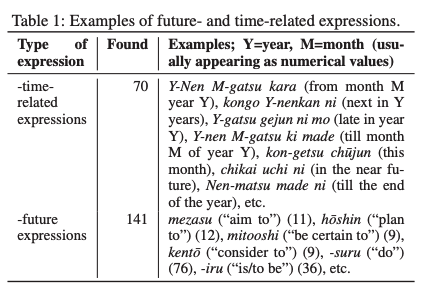
The authors curated their own dataset of Japanese expressions. They gathered these from various newspapers, such as the Nihon Keizai Shimbun, the Asahi Shimbun, and the Hokkaido Shimbun. From these newspapers, they extracted sentences that referenced the future (270). After that, they manually extracted the specific future expressions (141 unique future expressions, words, phrases, etc.), as well as time-related expressions (70). See Table 1.
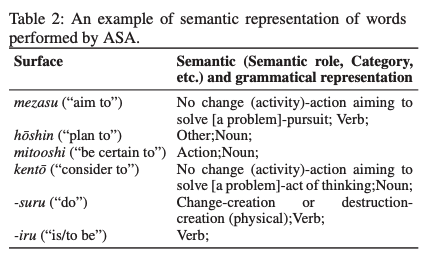
From these sentences, the authors then performed semantic role labeling (SRL) using ASA, a system developed by Takeuchi et al. 2010. They state, "Semantic role labeling provides labels for words according to their role in the present sentence context." The example they give is "John killed Mary” and they label each word as the following:
| Word | Semantic Role Label |
|---|---|
| John | actor |
| kill[past] | action |
| Mary | patient |
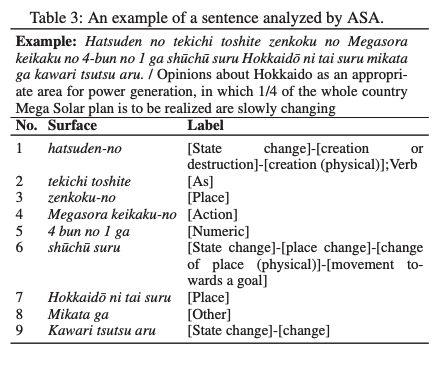
When no semantic representation is provided, the authors inferred the label by using a heuristic rule. For a more in-depth look at how SRL was applied, see Table 3.
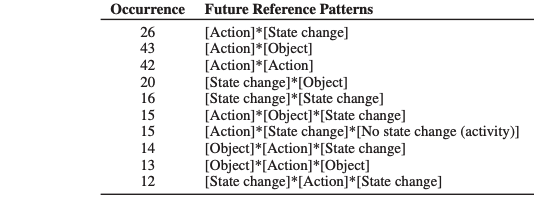
They passed these semantic role labels from ASA into another system called SPEC (Sentence Pattern Extraction arChitecturte), developed by Ptaszynski et al. 2011. My understanding is that SPEC has two use cases, one of which is "a system that automatically extracts frequent sentence patterns distinguishable for a corpus (a collection of sentences)." You could read the original SPEC paper or this paper by Nakajima et al. 2014 for more details on their methodology.
For this paper's experiments, they compiled 130 sentences referring to the future and 130 not referring to the future (past or present), totaling 260. The dataset breakdown is as follows:
| Dataset | Future Referencing Sentences | Not Referring to Future |
|---|---|---|
| set50 | 50 | 50 |
| set130 | 130 | 130 |
The core task is binary classification: determining whether a sentence is future-related or non-future-related across the two datasets above. They utilized SPEC-extracted frequent patterns as features. Read the paper by Yoko Nakajima et al. for additional methodological details and results.
What is Genuinely Novel
The extraction of sentence patterns and their frequencies across articles from three newspapers is an interesting aspect of the study. According to the authors, using sentence patterns that refer to the future represents a different approach from previous work, which primarily relied on explicit temporal expressions such as dates or time words. This is notable because it operates at a higher level of sentence semantics, potentially capturing future-oriented language that may not contain explicit time references. The approach could also serve as a foundation for more scalable systems that analyze large text collections, including real-time Social Networking Services (SNS), as discussed by the authors.
Limitations
The authors discuss the idea of "predicting a future trend by analyzing articles mentioning events related to the future," but they do not actually predict future trends. Instead, the paper focuses on identifying and classifying future-related expressions.
A limitation is that the researchers assume that patterns appearing most frequently can serve as useful feature expressions. This matters because less common patterns may be overlooked by the system, even if they contain important future-oriented information. In my view, this could become problematic in a real-world application, particularly given the authors' discussion of applying such methods to the real-time analysis of Social Networking Services (SNS). Social media platforms often contain highly varied, informal, and rapidly evolving language, meaning important future-related information may be expressed in ways that do not occur frequently in training data. For example, if a system were used to monitor disaster-related information on SNS and a rare linguistic pattern indicated that a hurricane was approaching, the system might fail to identify it if that pattern had not been learned effectively. As a result, individuals relying on such a system could miss important warning information and have less time to prepare.
The authors provide definitions for the unmodified pattern list, zero deleted, ambiguous deleted, length awarded, length awarded zero deleted, and length awarded ambiguous deleted configurations. However, the explanations are brief and somewhat abstract. Additional examples illustrating how each configuration modifies the pattern set would improve clarity and make the methodology easier to reproduce.
Ideas for Our Work
The semantic role labeling framework (e.g., actor, action, patient) aligns well with several TOLSA-M properties. More specifically, the actor can be viewed as analogous to a source, while the patient often corresponds to a target. Although the mappings are not exact, the paper demonstrates that semantic role representations can help structure information in a way that is compatible with TOLSA-M-style annotation.
Since they prioritize facts to make predictions, this confirms the TOLSA-M Epistemic dimension. The sub-dimension of deductive (this blog/paper), speculative, probabilistic, assertive, and certain matters as the everyday person can gauge the confidence of the source declaring the TOLSA-M. Read How confident are you?. Different modeling strategies could be utilized, such as one-vs-rest described in EventStatus Corpus.
TOLSA-M statements could potentially be used as features in future-oriented prediction systems. By explicitly modeling targets, outcomes, sources, and other properties, TOLSA-M representations may provide a richer view of future-referencing information than sentence patterns alone. Read more in Forward-looking statements.
A possible baseline for TOLSA-M research would be to adapt the ASA + SPEC pipeline described in this paper. TOLSA-M datasets could be evaluated both inter-dataset (each dataset independently) and intra-dataset (across datasets) to assess generalization. Similar to the authors' analysis of future-related and non-future-related patterns, explainability analyses could examine which semantic patterns contribute most strongly to TOLSA-M and non-TOLSA-M classifications.
The paper's discussion of real-time Social Networking Services (SNS) is also relevant to TOLSA-M research. A TOLSA-M system could first classify statements as TOLSA-M or non-TOLSA-M and then track them over time as new information becomes available. Such a system could support monitoring, verification, and user-facing updates regarding the correctness of previously identified TOLSA-M statements, helping users follow how TOLSA-M evolve across an SNS platform.
For more information about our research, return to our homepage: ufdatastudio.com.
For more from Detravious on NLP research (including the TOLSA-M Taxonomy), research and industry collaborations, faith in Jesus, and broader writings, visit: Research Portfolio | LinkedIn | Medium, or contact via email at dj.brinkley@ufl.edu.