Binary Temporality (Past or Future) Detection for News Content
Paper + Venue + Topic
This paper Detection of temporality at discourse level on financial news by combining Natural Language Processing and Machine Learning by Silvia García-Méndez et al., was published in the Expert Systems With Applications Journal in 2022. It focuses on the intersection of natural language processing, computational linguistics, and financial news, utilizing knowledge extraction, machine learning, and temporal analysis.
The Problem + Why it Matters
This work is motivated by the volume of real-world valuable financial data from sources like Bloomberg News, CNN Business, and Forbes. The availability of high-quality financial data is critical because investors leverage it to make informed decisions and assess market sentiment. Thus, there is a need not only for data volume and value, but also for a variety of sources, sufficient velocity to support timely decision-making, and, arguably most importantly, data veracity. Furthermore, veracity reflects a source's ability to communicate information accurately and reliably.
While this data is abundant, useful, comes from various streams, and must have a level of correctness, the financial market screening systems used to filter the data possess limited AI-based knowledge extraction (KE) capabilities. This limitation in KE matters because improved techniques may enable systems to identify information that previous approaches overlook.
More specifically, from the perspective of this paper, these systems capture contextual information; however, they overlook the ability to identify predictive knowledge. This is imperative for investors because they can leverage not only general information but also potential future performance to make decisions. Furthermore, by having access to predictions, investors may reduce uncertainty and emotional distress along with avoid losses in time, energy, and money. In order to identify predictive statements from contextual information and other types of statements, such as descriptions of past events, the authors argue for and empirically evaluate their system to detect temporality at the discourse level. With temporality as the focal point, the authors state:
Thus, temporal markers are not simply grammatical categories related to features like tense and aspect, but also temporal adverbial elements (for example: ‘‘a month ago’’, ‘‘today’’, ‘‘after’’, etc.) and complex verb structures such as phrasal verbs or compound verb phrases (e.g., ‘‘look forward’’, ‘‘begin to work’’).
The Method
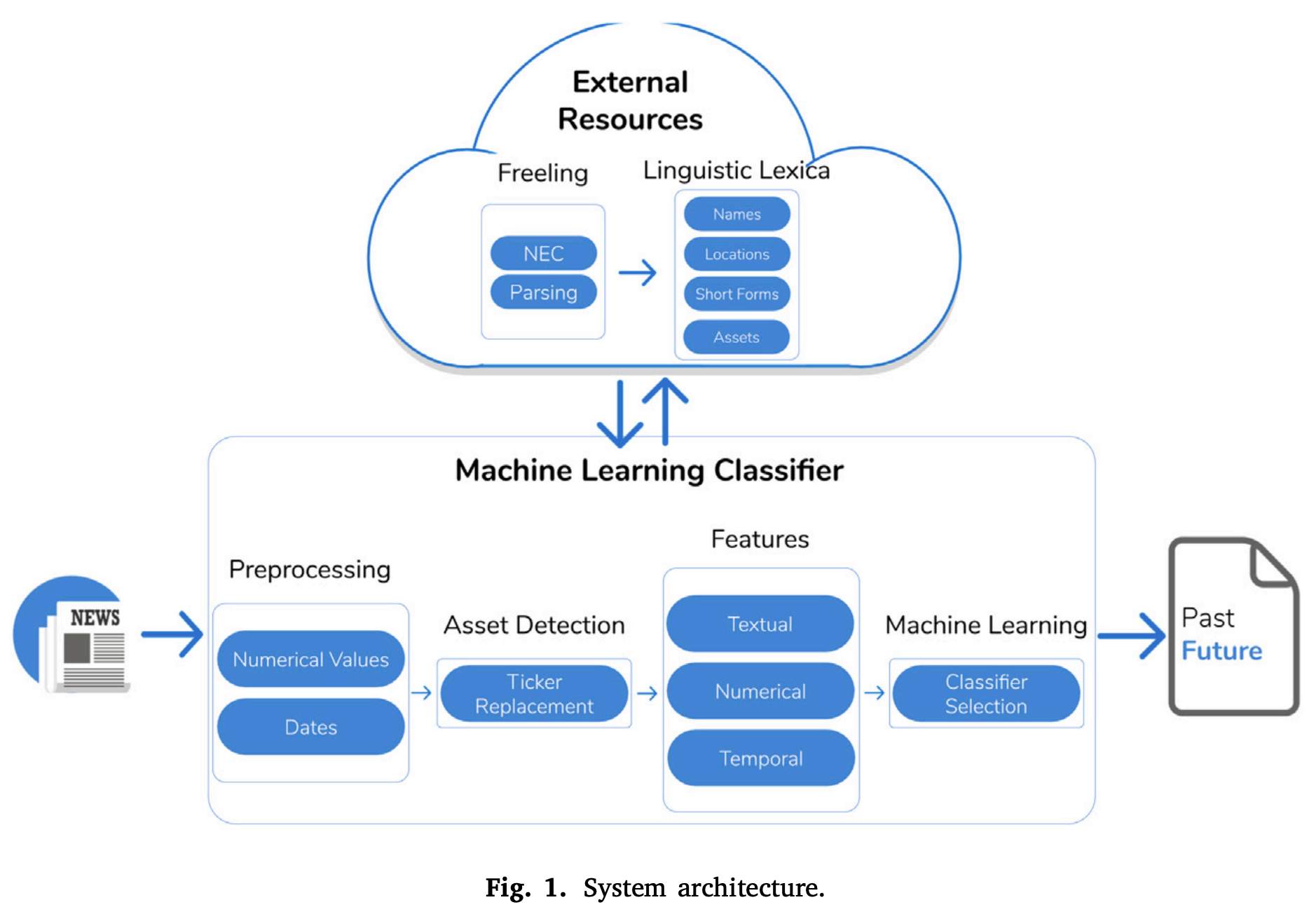
This is a binary classification problem on the temporality (past or future) of 600 news pieces derived from prestigious journals such as The New York Times and stock messaging boards such as Bloomberg. To achieve this, there is the Machine Learning Classifier that leverages External Resources.
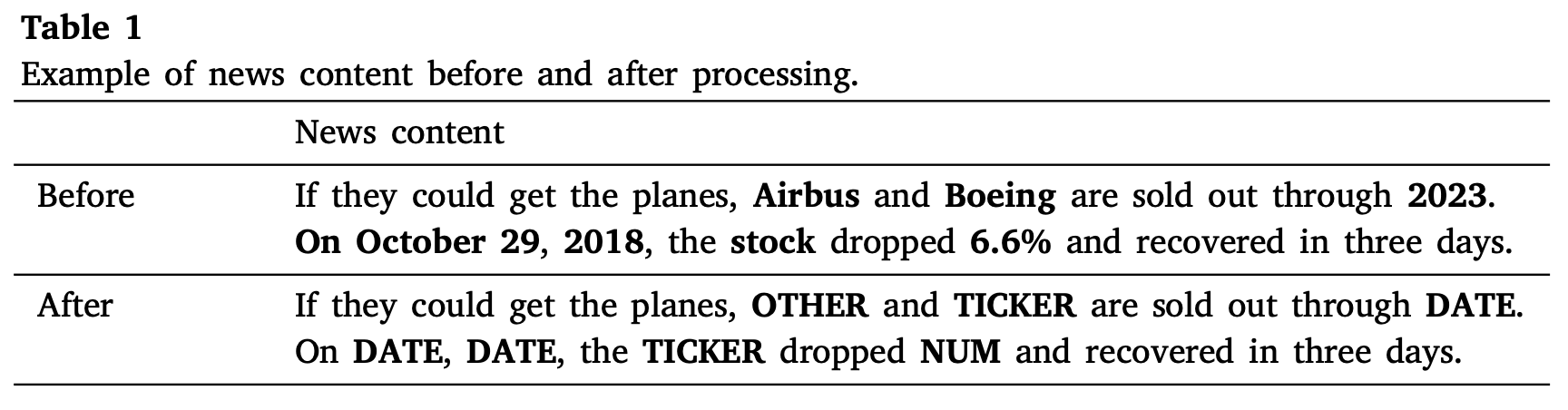
The system's first module converts the numerical values to a NUM or PERC tag and dates to a DATE tag. Furthermore, this module performs Named Entity Classification to label proper nouns with the NAME tag, locations with the LOC tag, and abbreviations with the ABB tag, while leveraging Freeling and Linguistic Lexica in the External Resources.
The next module is asset detection. This replaces nouns such as company, stock, etc with the TICKER or OTHER tag.
Then comes the feature extraction with types textual, numerical, and temporal. Each type has a feature name and description in table below.
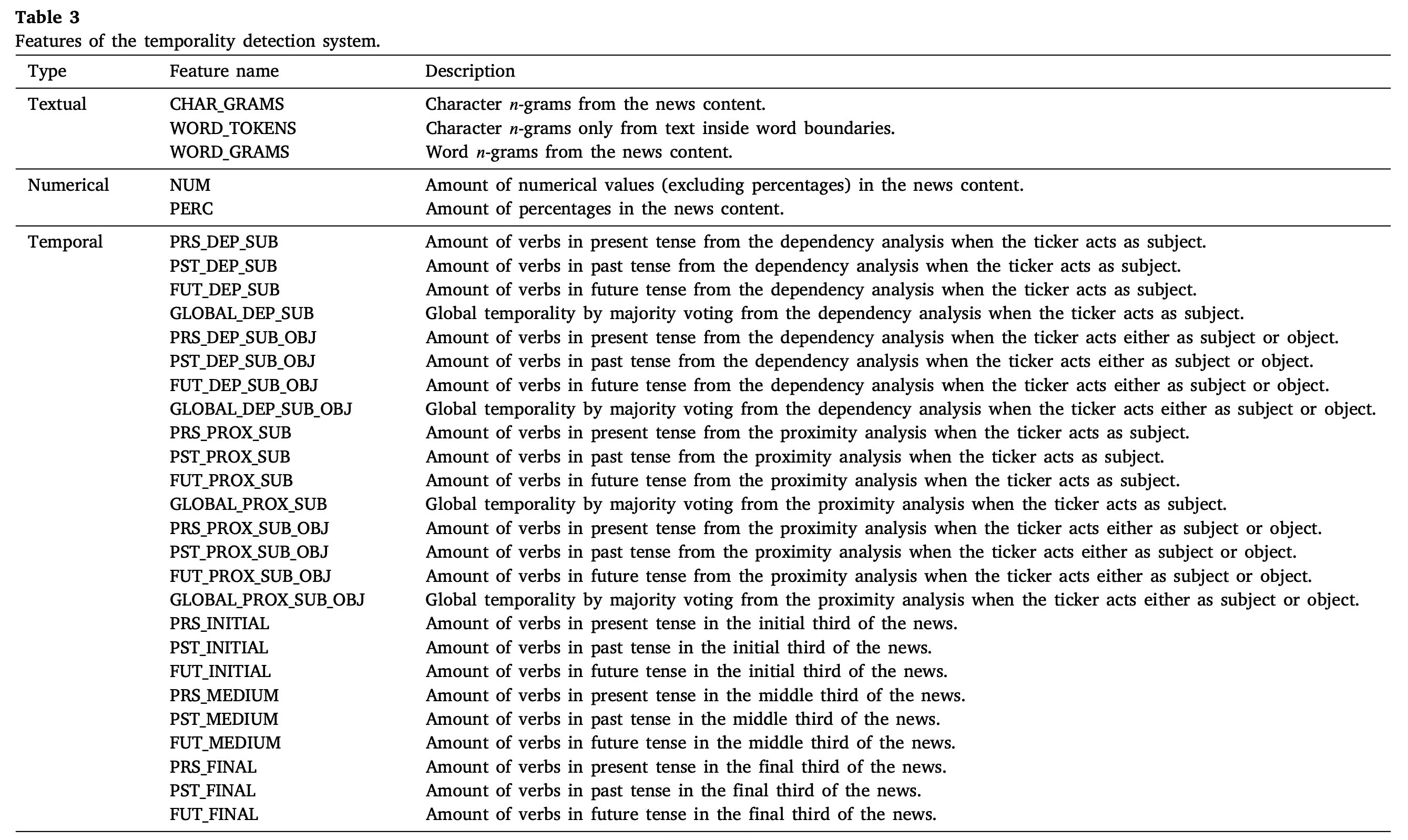
Leveraging the above, the last module is building and optimizing the classifiers. See the paper for runtime/complexity order, hardware specifications, and hyperparameter optimization.
The system's end goal is to label the input text as past or future.
The authors compare their system to a rule-based baseline based on syntactic and semantic rules. See the paper for more details.
What is Genuinely Novel
The main novelty is their application of this specific system to discourse-level temporality. Other works either consider a portion of their system or devise entirely different systems with different features such as keywords (e.g., prediction, forecast, etc) and applications (temporality as features to models).
Limitations
A significant limitation is the lack of public access to the code and the dataset, which prevents verification of the results. I reached out for their dataset and waiting to hear back. Additionally, there is a conceptual gap in the paper: the authors do not clearly distinguish between a general "opinion" and a "prediction," essentially treating any future-oriented opinion as a predictive statement.
Ideas for Our Work
The first idea for our work confirms the usage of properties and dimensions within the TOLSA-M Taxonomy. In this work, the authors used tags (e.g., NUM, DATE, TICKER, etc). Our application differs slightly from theirs as we do not replace words with the properties or dimensions because we want to process input text naturally. However, we collect the properties and dimensions as information and metadata for tasks other than binary classification.
The second idea leverages the temporality (past or future) for a news piece. We utilize this temporality slightly different in our TOLSA-M Taxonomy. An example is below as based on their work, they would label this as past.
"Charles Barkley predicted the Knicks would win the ECF on the season opener of Inside the NBA" (October 22, 2025).
Our reasoning for capturing this past-tense prediction as a TOLSA-M is to track the evolution of a narrative over time. For example, Charles originally made this prediction on October 22, 2025. Did he later revise or maintain that prediction? Capturing such statements enables longitudinal narrative tracking, allowing viewers to develop a more holistic perspective and better assess the consistency and veracity of a source.
The third idea relates to their rule-based guidelines and how they could be applied to our dataset. While we are not currently implementing this approach, it remains under consideration as a baseline for comparison against algorithmic methods (ML, DL, and LLMs) to establish true baseline performance.
The fourth idea is to link their thought of future-oriented opinion as a predictive statement to discourse genres (beliefs, claims, events, opinions, etc) as the research plan for our TOLSA-M Taxonomy is to connect with discourse genres. Our reasoning is to avoid inflating our true set of TOLSA-Ms and to ensure we don't miss out on TOLSA-Ms.
For more information about our research, return to our homepage: ufdatastudio.com.
For more from Detravious on NLP research (including the TOLSA-M Taxonomy), research and industry collaborations, faith in Jesus, and broader writings, visit: Research Portfolio | LinkedIn | Medium, or contact via email at dj.brinkley@ufl.edu.