Beyond Verb Tenses | Decoding Discourse-Level Temporality When NLP Meets ML for Financial Data
Paper + Venue + Topic
This paper Detection of temporality at discourse level on financial news by combining Natural Language Processing and Machine Learning by Silvia García-Méndez, Francisco de Arriba-Pérez, Ana Barros-Vila, Francisco J. González-Castaño, was published in the Expert Systems With Applications Journal in 2022. The paper focuses on extracting aspects of financial news using natural language processing (NLP) and machine learning (ML) to classify financial news as past or future temporality at the discourse level (the relational organization and temporal ordering of events across the text, beyond sentence-level verb tenses). To capture this discourse-level temporality, the authors combine ML techniques with three key linguistic strategies: clause segmentation, temporal modifiers, and positional temporal reference.
The Problem + Why it Matters
This work is motivated by the volume of high-quality financial data from sources like Bloomberg News, CNN Business, and Forbes. The availability and validity of financial data is critical because investors leverage it to assess the market's (e.g., bullish vs bearish) sentiment and, in turn, make informed decisions (e.g., buying or selling stocks). Thus, I posit there is a need not only for data volume, value, availability, and validity, but also for a variety of sources and sufficient velocity--supporting diverse, unbiased information, and timely decision-making. While this data is in alignment with the 6Vs of Big Data, financial market screening systems (FMSS) used to filter this data have clear limitations: AI-based knowledge extraction from text currently covers limited aspects.
More specifically, from the perspective of this paper, these systems capture contextual information; however, they overlook the ability to identify predictive knowledge. This is imperative for investors because they can leverage not only general information but also potential future performances mentioned in news articles to make decisions. Furthermore, by having access to predictive knowledge, investors may reduce uncertainty surrounding future performance outcomes and financial emotional distress, along with avoiding losses of time and money. In order to identify predictive statements from contextual information and other types of statements, such as descriptions of past events, García-Méndez et al. argue for and empirically evaluate their system to detect temporality at the discourse level (relational organization and temporal ordering of events across the text, beyond sentence-level verb tenses). With temporality as the focal point, the authors state:
Thus, temporal markers are not simply grammatical categories related to features like tense and aspect, but also temporal adverbial elements (for example: ‘‘a month ago’’, ‘‘today’’, ‘‘after’’, etc.) and complex verb structures such as phrasal verbs or compound verb phrases (e.g., ‘‘look forward’’, ‘‘begin to work’’).
The Method
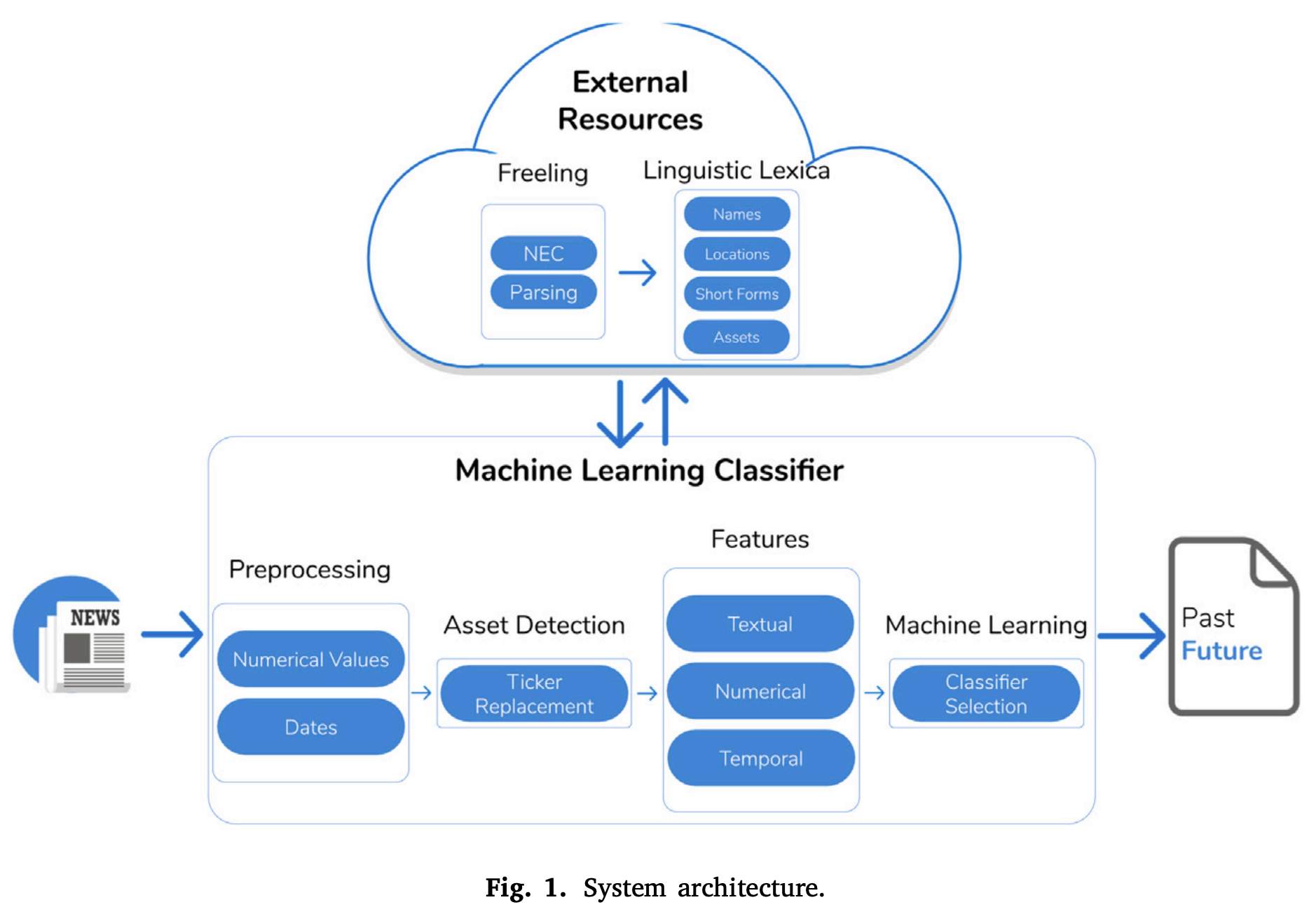
This is a binary classification problem on the temporality (past or future) of 600 news pieces derived from prestigious journals such as The New York Times and stock messaging boards such as Bloomberg. To achieve this, their system architecture (image above) encapsulates an ML Classifier (MLC) pipeline that leverages external resources alongside three key linguistic strategies (clause segmentation, temporal modifiers, and positional reference patterns) to process and classify temporality.
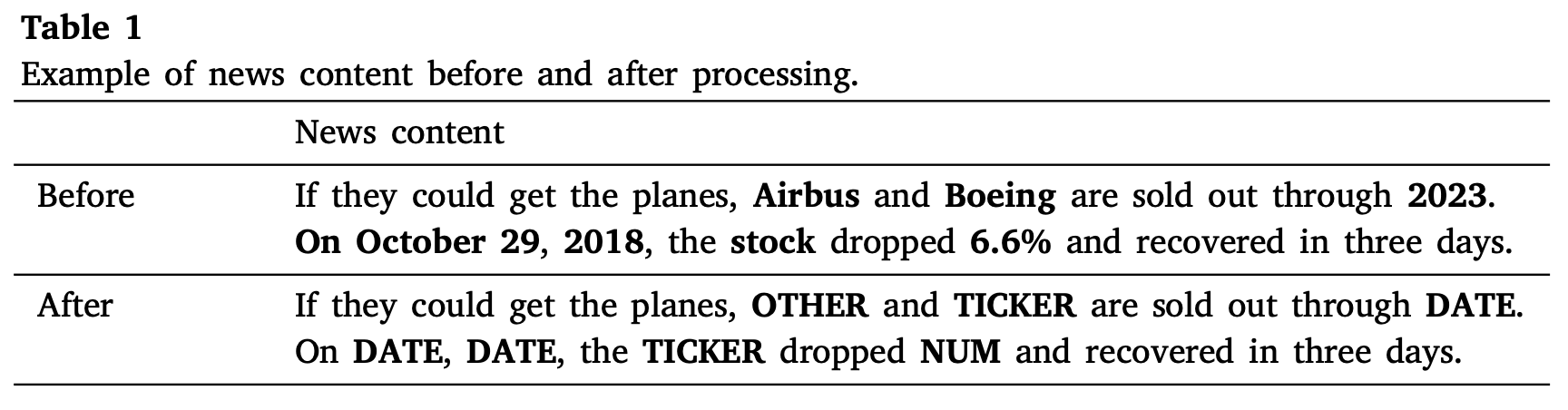
Module 1 (figure above) normalizes numbers and percentages into generic NUM and PERC tokens, and dates to a DATE token.
Furthermore, this module performs Named Entity Classification to label proper nouns with the NAME tag, locations with the LOC tag, and abbreviations with the ABB tag, while leveraging Freeling and Linguistic Lexica in the External Resources.
Module 2 (figure above) handles asset detection, replacing nouns such as company, stock, etc., with TICKER or OTHER tokens.
See the normalization example for Modules 1 and 2 below.
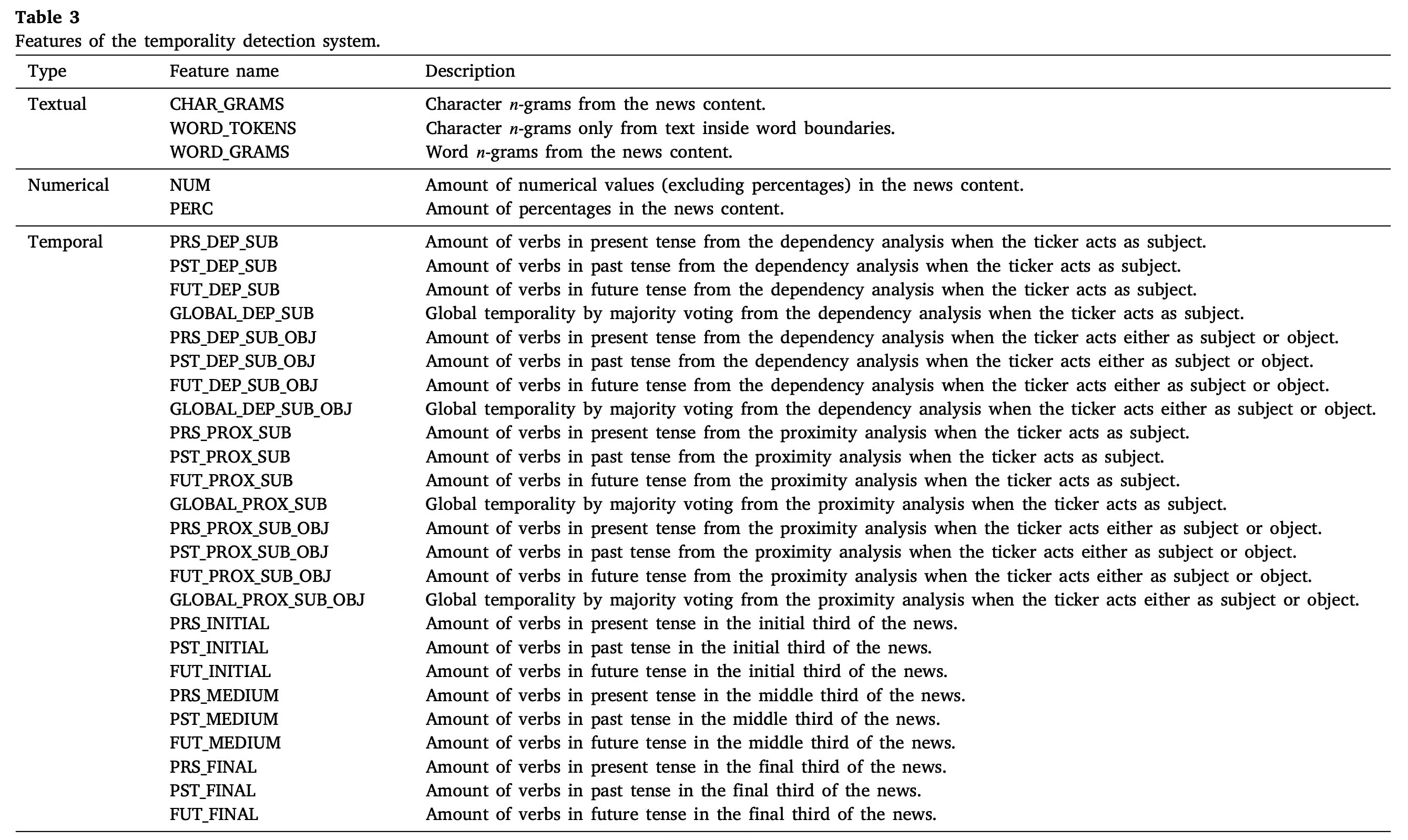
Once normalized, the system performs feature extraction with types (textual, numerical, and temporal). This is where the three key linguistic strategies (clause segmentation, temporal modifiers, and positions of temporal references) are implemented. In their paper, they state:
(1) Clause segmentation: to determine the continuity of tense in sequential clauses within the text, both across dependencies and by proximity.
(2) Temporal modifiers: more specifically expressions that directly modify the temporal data of a clause, for example by altering verb tense.
(3) Positions of temporal references: within the news are also considered, since authors tend to follow certain patterns, such as leaving predictions (future tenses) to the end.
See table below.
Leveraging these features, the final module builds and optimizes the classifiers (decision trees, random forests, support vector machines, and neural networks) to output Past or Future. These classifiers are evaluated against a rule-based baseline. See the paper for runtime/complexity order, hardware specifications, hyperparameter optimization, and results.
What is Genuinely Novel
The main novelty of their work lies in applying this system to discourse-level temporality. Other works either consider only a portion of such a pipeline or devise entirely different systems with features like keywords (e.g., "prediction", "forecast", etc.) and different applications (e.g., using temporality merely as features for downstream models).
The normalization of tokens (NUM, PERC, DATE, TICKER, OTHER) is effective because these are standard words across the financial domain, providing good generalizability within this domain.
The combination of the three key linguistic strategies (clause segmentation, temporal modifiers, and positions of temporal references) is vital because isolated verb tenses or keywords fail to capture complex temporal relationships across multi-sentence discourse. Integrating the three strategies allows the system to determine whether an author's opinion is genuinely forward-looking at the discourse level.
Limitations
- A significant limitation is the lack of public access to the code and the dataset, which prevents verification of the results. I reached out for their dataset. I am still waiting to hear back.
- Additionally, there is a conceptual gap in the paper: the authors do not clearly distinguish between general "opinions" (or event descriptions) and actual "predictions"—essentially treating any future-oriented statement as a predictive forecast.
- The focus on a single domain leaves generalizability to other domains untested.
Ideas for Our Work
-
Property Extraction and Metadata Collection: In this work, the authors normalize text using tokens like
NUM,PERC,DATE,TICKER, andOTHER. Our approach differs as we do not strip away critical domain context through destructive masking. Instead, we process the raw, uncorrupted text naturally to perform property extraction—isolating the Target, Outcome, Source, and Date. Our reasoning is that preserving the raw text maintains essential context for downstream tasks such as longitudinal narrative tracking and outcome correctness verification. Furthermore, we collect metadata to provide rich contextual information for tasks beyond binary classification. -
Past-Tense Predictions & Longitudinal Tracking: Standard binary temporality (past or future) classifiers map past grammatical tense directly to retrospective facts, discarding past-tense declarations. For example, under García-Méndez et al.'s framework, the statement below would be categorized simply as Past:
"Charles Barkley predicted the Knicks would win the ECF on the season opener of Inside the NBA" (October 22, 2025).
Although declared in the past, the outcome (whether the Knicks win the ECF) was entirely unknown at the time of declaration and at the time of resurfacing (May 27, 2026). TOLSA-M captures these past-tense forecasts to enable a holistic perspective of longitudinal narrative tracking—allowing systems to trace whether a source later revises, doubles down on, or fulfills their prediction, ultimately auditing source consistency and outcome veracity over time.
-
Rule-Based Diagnostic Baselines: While we are not currently implementing a rule-based approach, their syntactic and semantic guidelines remain under consideration as a diagnostic baseline against algorithmic methods (ML, DL, and LLMs) to establish true baseline performance.
-
Discourse Genre Disambiguation: A major conceptual gap in prior work is the conflation of general future-oriented opinions and event descriptions with actual forecasts. To prevent inflating the set of positive predictions (a key limitation in existing datasets), TOLSA-M explicitly links predictive declarations to specific discourse genres (e.g., claims, beliefs, scheduled events, rumors). This ensures a high-precision boundary that separates true target-outcome predictions from non-predictive event descriptions or generic forward-looking commentary.
For more information about our research, return to our homepage: ufdatastudio.com.
For more from Detravious on NLP research (including the TOLSA-M Taxonomy), research and industry collaborations, faith in Jesus, and broader writings, visit: Research Portfolio | LinkedIn | Medium, or contact via email at dj.brinkley@ufl.edu.