Gators at WMT26: Retrieval-Augmented Many-Shot Translation for Low-Resource Northeast Indian Languages
The WMT26 Low-Resource Indic Language Translation Shared Task asks systems to translate between English and eleven North-Eastern Indian languages. Most of these languages have little parallel data, and the training banks range from under 1,000 pairs for Karbi to over 170,000 pairs for Assamese. Team Gators submitted a system that uses no fine-tuning. It retrieves similar parallel examples and places them in the prompt for Gemini 2.5 Flash.
This post describes the system, the data behind it, and how it ranks against the other primary systems in the shared task. The paper, code, and an interview with the students are linked at the end.
Where the method comes from
The approach adapts the machine translation component of the system we submitted to the AmericasNLP 2026 Shared Task on Cultural Image Captioning for Indigenous Languages. That system first produced Spanish captions as an interlingua. It then translated them into Indigenous languages with retrieval-augmented many-shot prompting. Our ACL 2026 post covers that shared task. For WMT26, we removed the captioning step, so the source sentence goes straight into retrieval.
How the system works
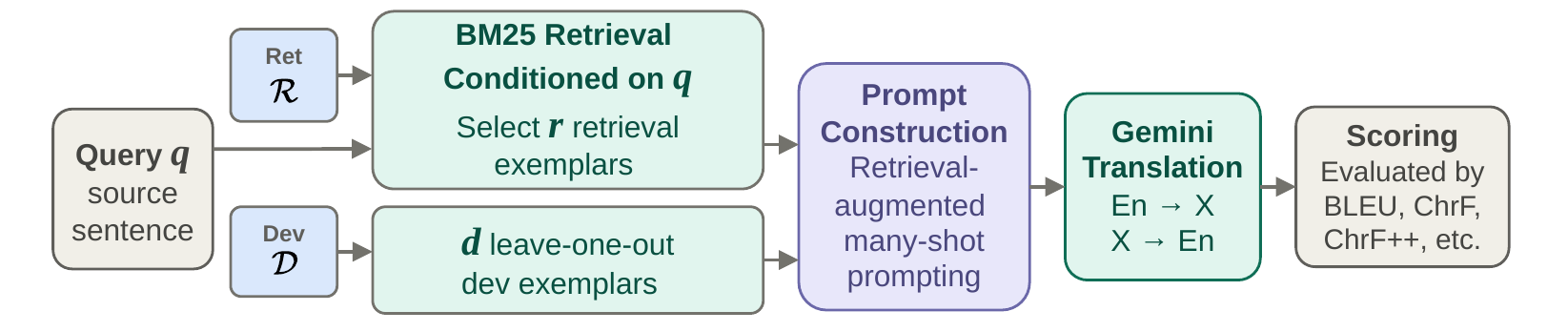
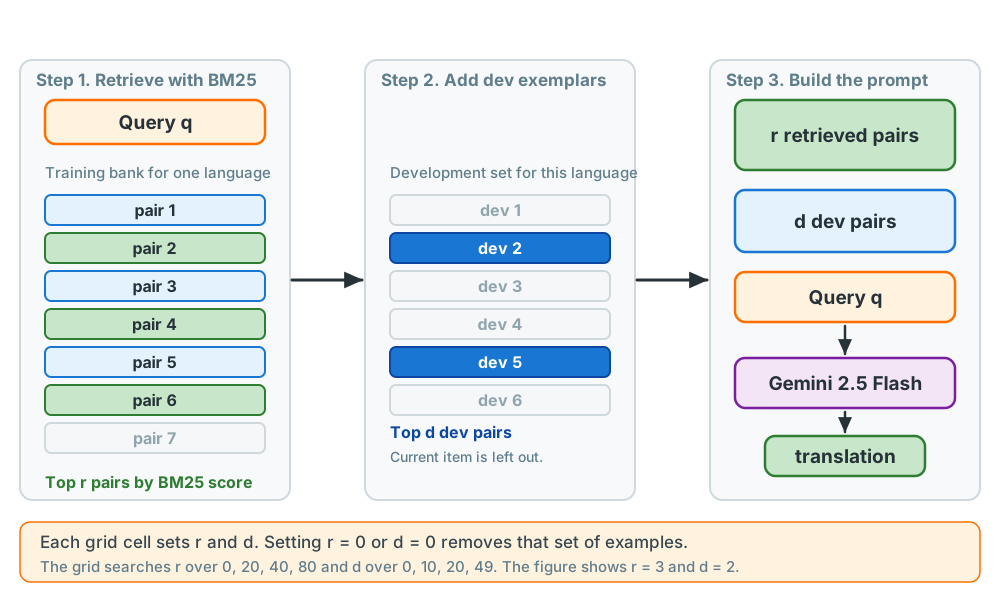
Each source sentence goes through a BM25 index built on a language-specific training bank. The index returns the r most similar parallel examples. The prompt also adds d leave-one-out examples from the development set. Gemini 2.5 Flash then translates the sentence using that many-shot prompt.
The training banks combine the official WMT26 data with publicly available corpora, including Samanantar. The shared task tests translation in both English to Indic and Indic to English directions. Both directions use the same pipeline, and only the source and target languages change.
The data
The eleven languages fall into two categories. Category 1 covers Assamese, Mizo, Khasi, Manipuri, Meitei, and Nyishi. Category 2 covers Bodo, Kokborok, Karbi, Nagamese, and Tagin. Manipuri appears twice because the shared task treats the Bengali and Meitei Mayek scripts as separate tracks.
| Language | Category | WMT26 samples | Augmentation ratio | Total pairs |
|---|---|---|---|---|
| Assamese | 1 | 52,440 | 3.3 | 171,794 |
| Mizo | 1 | 49,293 | 1.0 | 50,620 |
| Khasi | 1 | 25,495 | 0.9 | 22,847 |
| Manipuri (Bengali script) | 1 | 22,539 | 1.0 | 22,544 |
| Meitei (Meitei Mayek script) | 1 | 16,312 | 1.0 | 16,312 |
| Nyishi | 1 | 49,613 | 1.0 | 49,793 |
| Bodo | 2 | 12,268 | 9.3 | 114,410 |
| Kokborok | 2 | 2,040 | 1.0 | 2,102 |
| Karbi | 2 | 864 | 1.0 | 899 |
| Nagamese | 2 | 1,798 | 5.7 | 10,169 |
| Tagin | 2 | 4,703 | 0.9 | 4,421 |
The augmentation ratio measures how much the public corpora add to the shared task data. Bodo grows 9.3 times and Nagamese 5.7 times, while most other languages stay close to 1.0.
We also tried synthetic exemplars built with the MultiScript30k procedure (Driggers-Ellis et al., 2025). We observed no performance gain for Assamese, Mizo, or Manipuri, so the synthetic data stays out of the final corpora. Multi30k, the dataset behind MultiScript30k, consists of image captioning data, which does not match the domain of the shared task.
Choosing r and d
Two settings control the prompt. The value r sets the number of retrieved exemplars, and d sets the number of development exemplars. We searched r over 0, 20, 40, and 80 and d over 0, 10, 20, and 49. Each cell was scored with ChrF on a pilot set of 50 WMT26 samples, and each language and direction uses its best cell. Across the 11 languages and both directions, the full grid covers 352 cells. The grid search code is in the repository linked below.
How Gators ranks
The shared task findings paper (Pakray et al., 2026) publishes a results table for every language pair. Each table lists the primary systems with BLEU, ChrF++, and other metrics. We read those tables and compared Gators' primary system with the best other primary system on ChrF++. The findings paper reports results for 20 of the 22 pairs, and Nyishi has no published scores.
Gators has the highest ChrF++ among primary systems in 10 of the 20 pairs. Its largest leads come from English to Karbi (+11.32 ChrF++), English to Manipuri in Meitei Mayek script (+6.65), and Khasi to English (+4.26). Gators falls behind in 10 pairs. The widest gaps appear in the Category 2 languages Tagin to English (−31.23) and Karbi to English (−19.87), where VoxNexus-Translate leads.
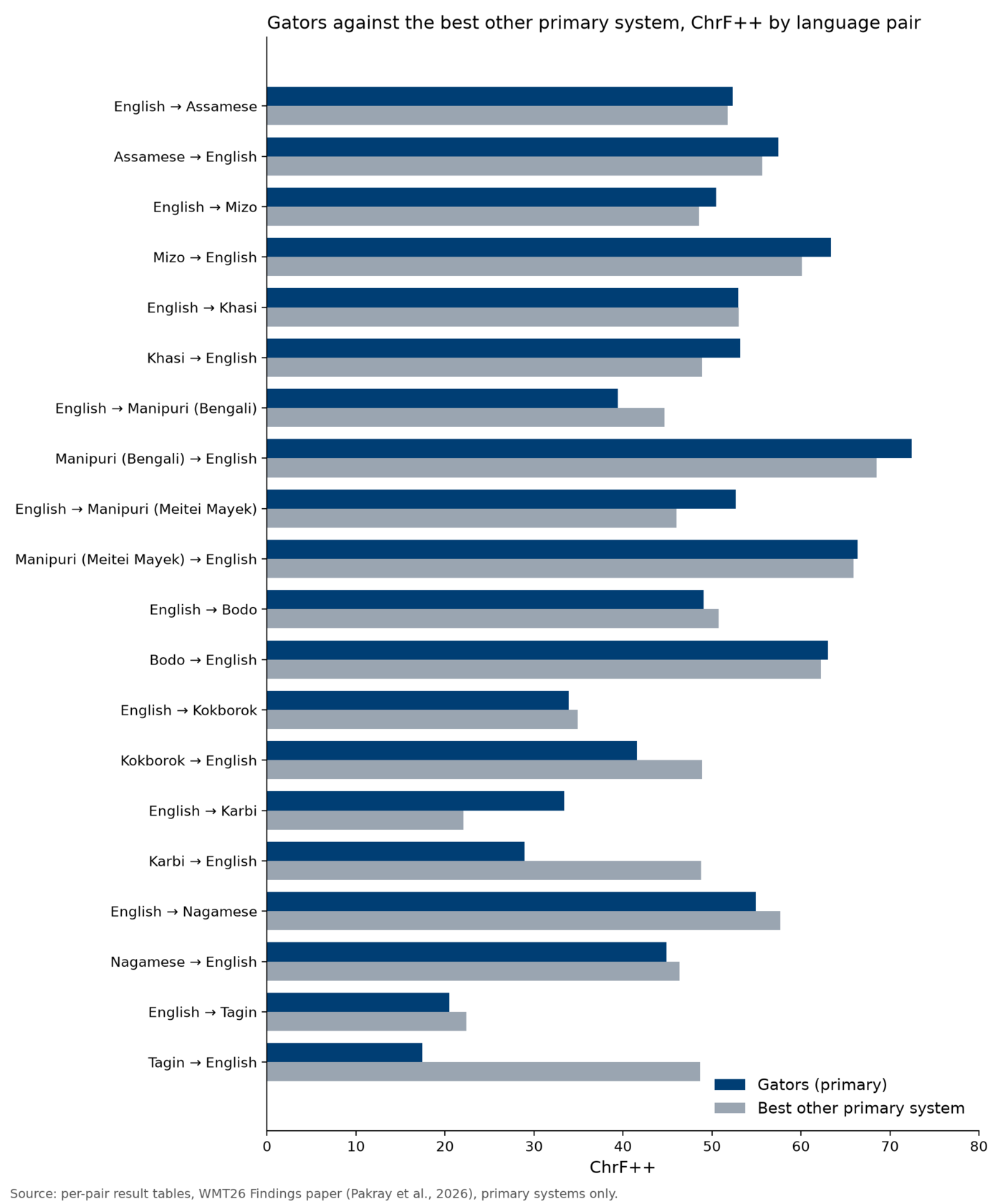
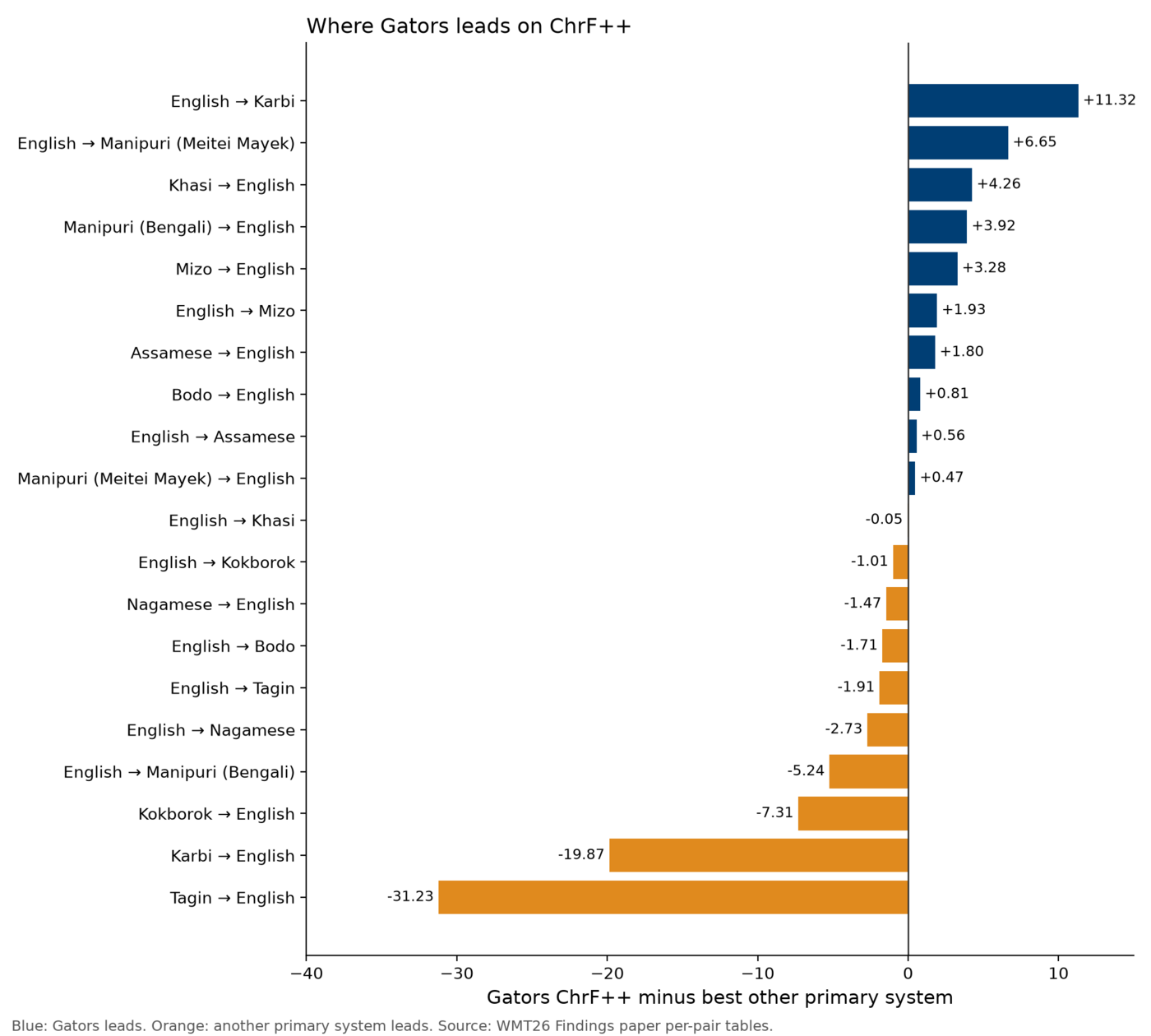
The margin view shows a split by direction. Gators leads on six of the ten Indic to English pairs with published scores, and on four of the ten English to Indic pairs. English to Manipuri in Bengali script is one of the larger gaps on the English to Indic side. Gators ranks sixth there, while the same language in Meitei Mayek script ranks first.
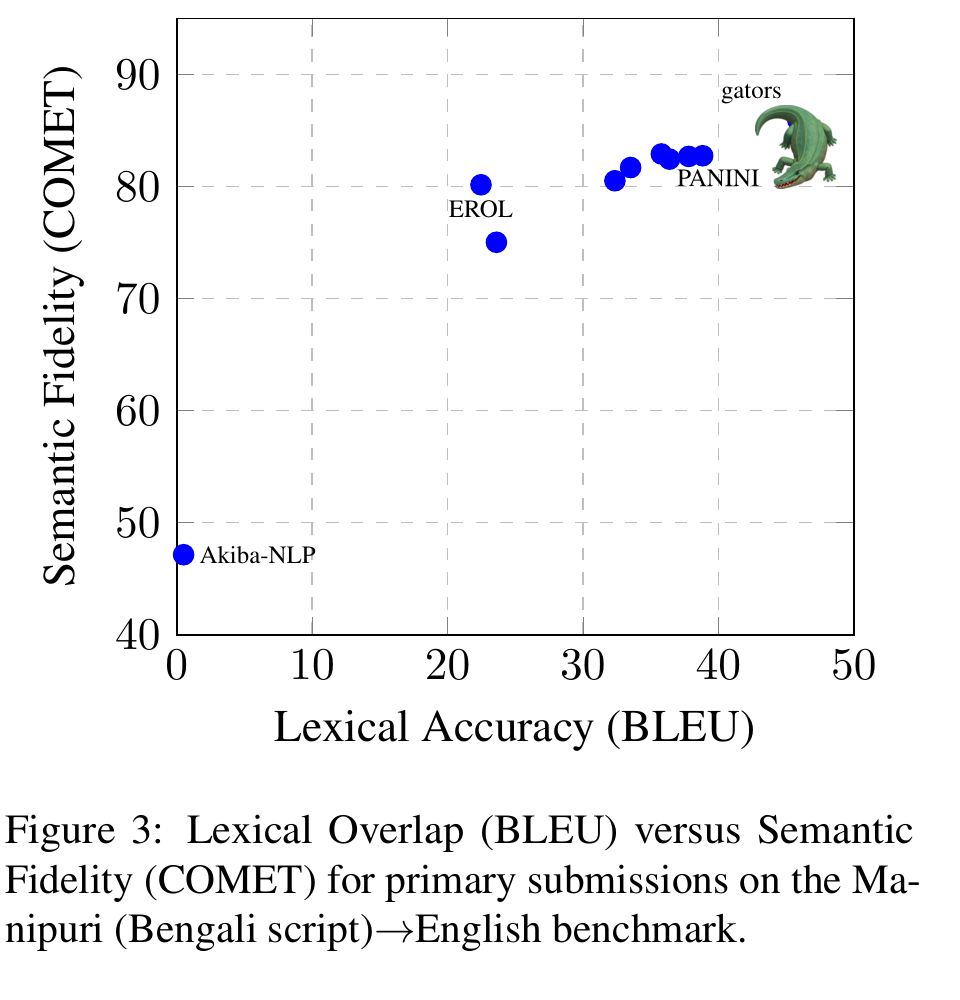
Figure 3 from the findings paper plots lexical overlap (BLEU) against semantic fidelity (COMET) for primary submissions on the Manipuri (Bengali script) to English task. In that comparison, Gators sits at the top right with 45.86 BLEU and 85.93 COMET.
What we found
Three observations stand out from our experiments.
Dev-to-test performance losses were stronger for Category 2 languages. The exception is English to Nagamese.
Domain match appears to influence the gains from synthetic exemplars more strongly than the augmentation ratio does.
Manipuri and Meitei are the same spoken language written in Bengali and Meitei Mayek scripts. Their scores differ substantially. We conjecture that Gemini saw far more Bengali script during pretraining.
Citing this work
If you use the system or the results, please cite the WMT26 system paper. The AmericasNLP paper describes the method this system builds on, and the findings paper is the source of the comparison above.
WMT26 system paper:
@inproceedings{dhawan2026bretrieval,
    title = "{BM25}-Augmented Many-Shot Translation for Low-Resource North-Eastern Indian Languages",
    author = "Dhawan, Aashish and
      Kasinets, Dzmitry and
      Driggers-Ellis, Christopher and
      Grant, Christan",
    booktitle = "Proceedings of the Eleventh Workshop on Machine Translation (WMT) under EMNLP 2026",
    year = "2026",
    address = "Budapest, Hungary",
    url = "https://www2.statmt.org/wmt26/pdf/2026.wmt-1.150.pdf"
}
AmericasNLP 2026 shared task paper:
@inproceedings{dhawan2026retrieval,
    title = "Retrieval-Augmented Long-Context Translation for Cultural Image Captioning: {G}ators Submission for {A}mericas{NLP} 2026 Shared Task",
    author = "Dhawan, Aashish and
      Driggers-Ellis, Christopher and
      Kasinets, Dzmitry and
      Grant, Christan and
      Wang, Daisy Zhe",
    booktitle = "Proceedings of the Sixth Workshop on NLP for Indigenous Languages of the Americas (AmericasNLP)",
    month = jul,
    year = "2026",
    address = "San Diego, California",
    publisher = "Association for Computational Linguistics",
    url = "https://aclanthology.org/2026.americasnlp-6.19"
}
WMT26 findings paper:
@inproceedings{pakray-etal-2026-findings,
    title = "Findings of {WMT} shared task on Low-resource {I}ndic Languages Translation",
    author = "Pakray, Partha and Pal, Santanu and Vetagiri, Advaitha and Singh, Kshetrimayum Boynao and Dash, Sandeep Kumar and Maji, Arnab Kumar and Lyngdoh, Saralin A. and Laitonjam, Lenin and Jamatia, Anupam and Das, Ajit and Warjri, Sunita and Sharma, Uzzal and Sambyo, Koj and Manna, Riyanka",
    booktitle = "Proceedings of the Eleventh Workshop on Machine Translation (WMT) under EMNLP 2026",
    year = "2026",
    address = "Budapest, Hungary",
    url = "https://www2.statmt.org/wmt26/pdf/2026.wmt-1.53.pdf"
}
Resources
- WMT26 system paper
- Poster (PDF)
- WMT26 findings paper
- AmericasNLP 2026 paper
- Code and grid search scripts on GitHub
- MultiScript30k on arXiv
Team
Aashish Dhawan, Christopher Driggers-Ellis, Dzmitry Kasinets, Daisy Zhe Wang, and Christan Grant. Team Gators is a collaboration between the UF Data Studio and the Data Science Research Lab.
For more information about our research, return to our homepage: ufdatastudio.com.