CIS 6930 Spring 26

Data Engineering at the University of Florida
Embeddings Primer
Supplementary Material for RAG Architecture
CIS 6930 - Data Engineering with LLMs
Why Embeddings?
RAG requires converting text to vectors for similarity search.
The problem: Computers work with numbers, not words.
The solution: Map text to dense numerical vectors where:
- Similar meanings → nearby vectors
- Different meanings → distant vectors
This enables semantic search beyond keyword matching.
Roadmap: From Words to Embeddings
| Era | Method | Key Idea |
|---|---|---|
| 1990s | One-Hot Encoding | Binary vectors, no semantics |
| 2000s | TF-IDF | Term importance weighting |
| 2013 | Word2Vec | Learn from context |
| 2018+ | Transformers | Contextual embeddings |
| Now | Sentence Transformers | Full sentence meaning |
One-Hot Encoding
Simplest approach: Each word gets a unique binary vector.
| Word | Vector |
|---|---|
| dog | [1, 0, 0, 0, 0, 0, 0] |
| cat | [0, 1, 0, 0, 0, 0, 0] |
| person | [0, 0, 1, 0, 0, 0, 0] |
| holding | [0, 0, 0, 1, 0, 0, 0] |
Problems:
- No semantic similarity (dog and cat equally different from “tree”)
- Vectors are huge (vocabulary size)
- Sparse and inefficient
Slide adapted from V. Ordonez
Bag-of-Words Representation
Represent documents by word counts:
| Document | dog | cat | person | holding | tree |
|---|---|---|---|---|---|
| “person holding dog” | 1 | 0 | 1 | 1 | 0 |
| “person holding cat” | 0 | 1 | 1 | 1 | 0 |
Still no semantics: “dog” and “cat” treated as completely unrelated.
Slide adapted from V. Ordonez
The Distributional Hypothesis
“You shall know a word by the company it keeps.” — J.R. Firth, 1957
Key insight: Words that appear in similar contexts have similar meanings.
- “The cat sat on the mat”
- “The dog sat on the mat”
Both “cat” and “dog” appear in the same context → they must be semantically related.
Document Frequency: Rare vs Common Terms
Intuition: Rare terms are more informative than common terms.
| Term | Appears In | Informativeness |
|---|---|---|
| “the” | 99% of docs | Very low |
| “algorithm” | 5% of docs | Medium |
| “arachnocentric” | 0.001% of docs | Very high |
If a query contains “arachnocentric” and a document contains it, that document is likely relevant.
TF-IDF: Term Frequency × Inverse Document Frequency
TF (Term Frequency): How often does the term appear in this document?
\[\text{TF}(t, d) = \frac{\text{count of } t \text{ in } d}{\text{total terms in } d}\]IDF (Inverse Document Frequency): How rare is this term across all documents?
\[\text{IDF}(t) = \log\left(\frac{N}{\text{df}_t}\right)\]TF-IDF:
\[\text{TF-IDF}(t, d) = \text{TF}(t, d) \times \text{IDF}(t)\]TF-IDF in Python
from sklearn.feature_extraction.text import TfidfVectorizer

corpus = [
    "The quick brown fox jumps over the lazy dog",
    "The dog barks at the fox",
    "The fox is quick and clever"
]

vectorizer = TfidfVectorizer()
tfidf_matrix = vectorizer.fit_transform(corpus)

# Get feature names (vocabulary)
print(vectorizer.get_feature_names_out())
# ['and', 'at', 'barks', 'brown', 'clever', 'dog', ...]

# Each row is a document vector
print(tfidf_matrix.toarray())
Word2Vec: Learning from Context
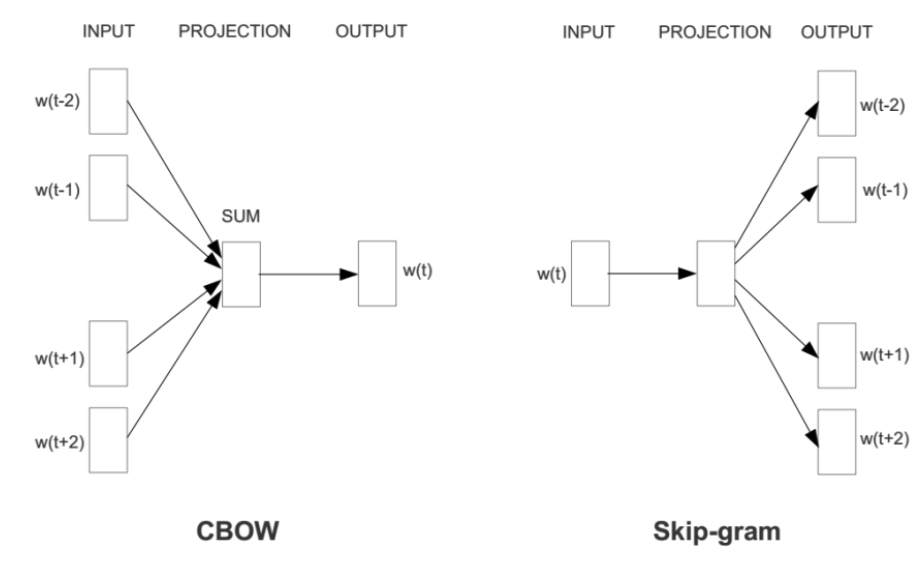
Key idea: Predict surrounding words from a center word (or vice versa).
Two architectures:
- CBOW: Predict center word from context
- Skip-gram: Predict context from center word
"The cat sat on the floor"

CBOW: [the, sat, on, the] → predict "cat"
Skip-gram: "sat" → predict [the, cat, on, the]
CBOW vs Skip-gram
CBOW (Continuous Bag of Words):
- Input: context words (surrounding words)
- Output: predict the center word
- Faster to train
- Better for frequent words
Skip-gram:
- Input: center word
- Output: predict context words
- Slower but more accurate
- Better for rare words and small datasets
Word2Vec: The Interesting Result
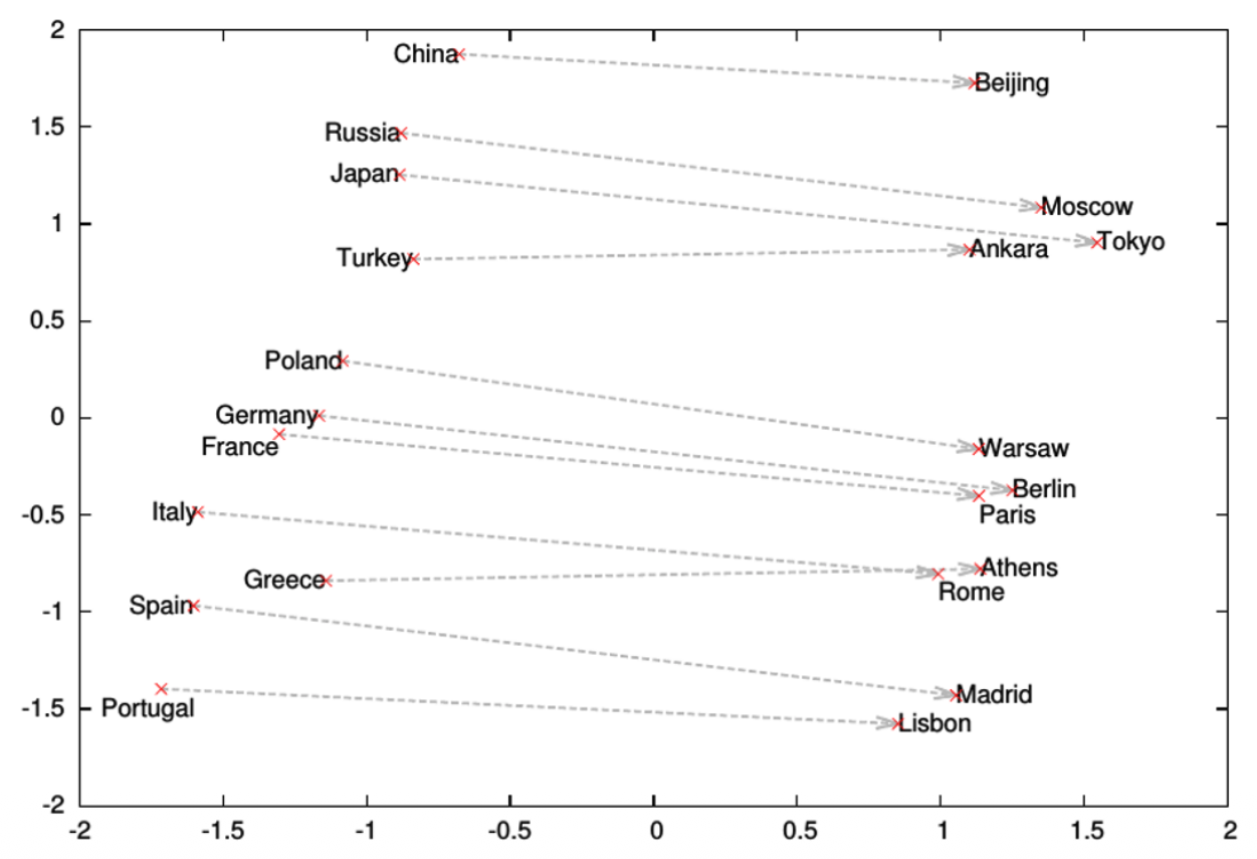
Word vectors capture semantic relationships through arithmetic:
\[\vec{king} - \vec{man} + \vec{woman} \approx \vec{queen}\]More examples:
- Paris - France + Italy ≈ Rome
- Bigger - Big + Small ≈ Smaller
The learned vectors encode analogical relationships. These relationships are approximate and depend on the training corpus.
From Words to Sentences
Problem: Word2Vec gives word vectors, but RAG needs document/chunk vectors.
Simple solution: Average the word vectors.
def document_vector(doc, word2vec_model):
    words = doc.split()
    vectors = [word2vec_model[w] for w in words if w in word2vec_model]
    return np.mean(vectors, axis=0)
Better solution: Use models trained for sentence similarity.
Sentence Transformers (2019+)
SBERT (Sentence-BERT): Fine-tune BERT for sentence similarity.
from sentence_transformers import SentenceTransformer

model = SentenceTransformer('all-MiniLM-L6-v2')

sentences = [
    "The cat sat on the mat",
    "A feline rested on the rug",
    "The stock market crashed today"
]

embeddings = model.encode(sentences)
# embeddings.shape: (3, 384)
Sentences 1 and 2 will have high cosine similarity; sentence 3 will be distant.
Measuring Similarity: Cosine Similarity
Cosine similarity: Measures angle between vectors (ignores magnitude).
\[\cos(\theta) = \frac{\vec{A} \cdot \vec{B}}{||\vec{A}|| \times ||\vec{B}||}\]from sklearn.metrics.pairwise import cosine_similarity
# Compare two embeddings
similarity = cosine_similarity([emb1], [emb2])[0][0]
# Range: -1 (opposite) to 1 (identical)
For RAG: Higher cosine similarity = more relevant document.
Euclidean Distance
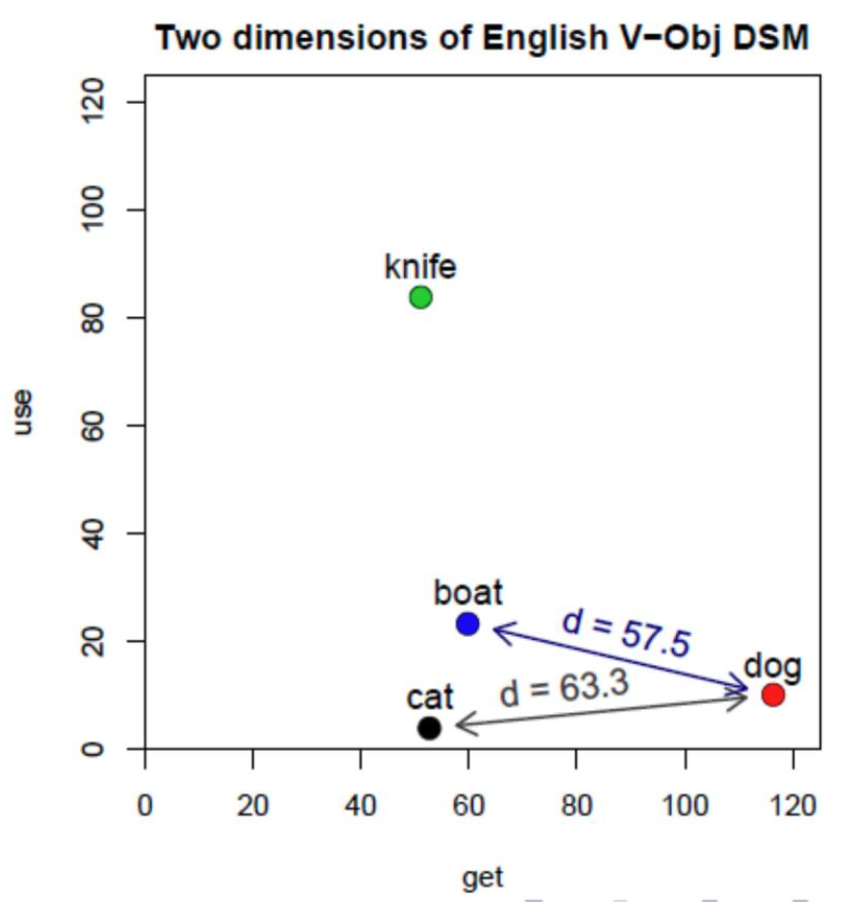
Euclidean Distance:
- Measures straight-line distance
- Affected by vector magnitude
Example: Using dimensions “use” and “get”:
- Distance(boat, dog) = 57.5
- Distance(cat, dog) = 63.3
Boat appears closer to dog than cat does, which is counterintuitive for semantic similarity.
Cosine Similarity
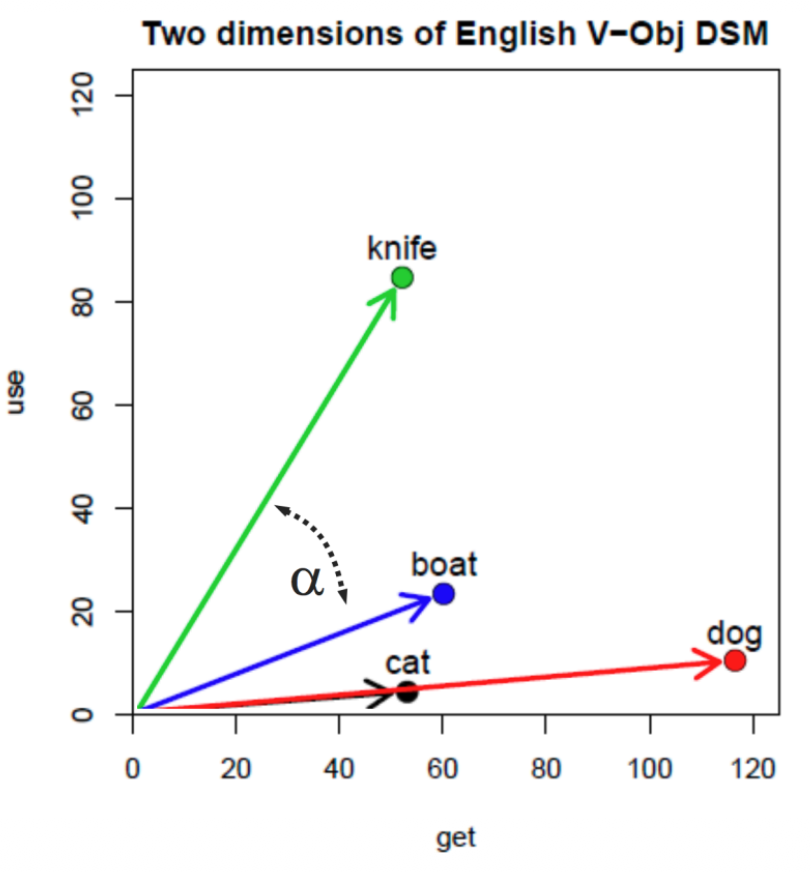
Cosine Similarity:
- Measures angle between vectors
- Ignores magnitude (normalized)
Example: Same words, same dimensions:
- Cat and dog have a small angle between them
- Cosine similarity correctly identifies their semantic relationship
Normalization removes the effect of word frequency, making cat and dog similar regardless of how often they appear.
Why Cosine for Text Similarity?
For text similarity: Cosine similarity is preferred because document length shouldn’t affect similarity.
- A short document about “dogs” should match a long document about “dogs”
- Euclidean distance would penalize the length difference
- Cosine similarity focuses on the direction (meaning), not magnitude (length)
Slides from Louis-Philippe Morency
Embedding Models for RAG
| Model | Dimensions | Speed | Quality |
|---|---|---|---|
all-MiniLM-L6-v2 |
384 | Fast | Good |
all-mpnet-base-v2 |
768 | Medium | Better |
text-embedding-3-small (OpenAI) |
1536 | API | Excellent |
text-embedding-3-large (OpenAI) |
3072 | API | Best |
Trade-off: Larger embeddings = better quality but slower search and more storage.
Using Embeddings in RAG
from sentence_transformers import SentenceTransformer

model = SentenceTransformer('all-MiniLM-L6-v2')

# 1. Embed your documents (offline)
doc_embeddings = model.encode(documents)

# 2. Embed the query (online)
query_embedding = model.encode(query)

# 3. Find most similar documents
similarities = cosine_similarity([query_embedding], doc_embeddings)[0]
top_k_indices = similarities.argsort()[-k:][::-1]
relevant_docs = [documents[i] for i in top_k_indices]
Summary
- Embeddings convert text to dense vectors
- TF-IDF weights terms by importance (sparse)
- Word2Vec learns from context (dense, word-level)
- Sentence Transformers encode full sentences (dense, sentence-level)
- Cosine similarity measures semantic relatedness
- RAG uses embeddings for semantic retrieval
For Assignment 2: You’ll use sentence-transformers to embed chunks and queries.
References
- Mikolov et al. (2013) - Word2Vec
- Reimers & Gurevych (2019) - Sentence-BERT
- MTEB Leaderboard - Embedding model benchmarks
Slides adapted from L.P. Morency, V. Hristidis, V. Ordonez</div>